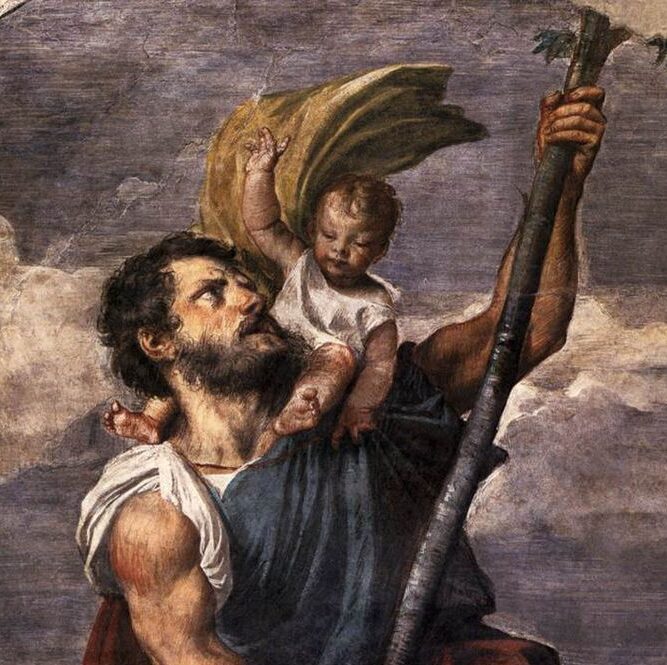
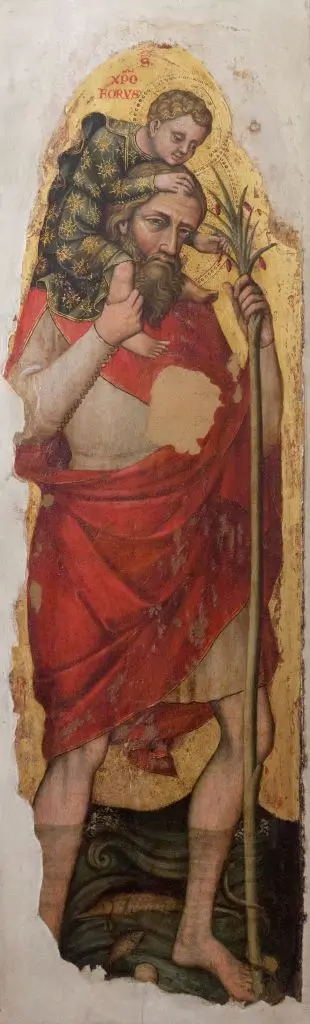
On this page you will find the evolution of Saint Christopher’s iconography across the centuries — a kind of art history seen through the lens of Saint Christopher.
Images of Saint Christopher Through Time
Between the 8th and 13th Centuries: Before the Golden Legend
Before becoming a ferryman, Saint Christopher was a martyr, a soldier, a king. And above all — he carries no Child!
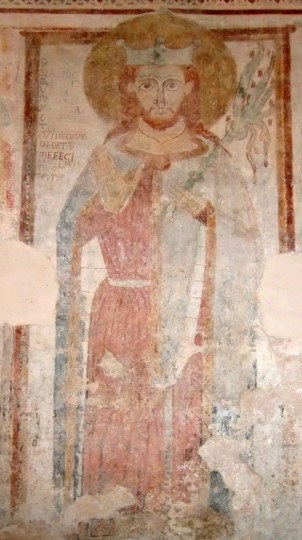
Saint Christopher before the Golden Legend
The Golden Legend
The Legenda Aurea, written by Jacopo da Varagine at the end of the 13th century, is the primary source on which all subsequent iconography drew. It most likely developed the ferryman narrative to show how Saint Christopher is, in the truest sense, a bearer of Christ — from the name, to the legend.
The Golden Legend (in Latin)
The Golden Legend (in Italian)
After the Golden Legend: 13th–16th Centuries
Saint Christopher’s moment of great triumph. Everyone wants him, everyone prays to him, everyone depicts him. For public and private devotion alike, representations of the saint multiply — protector of pilgrims, keeper of terrible afflictions at bay (from sudden death to the plague), and patron of a vast array of people and professions.
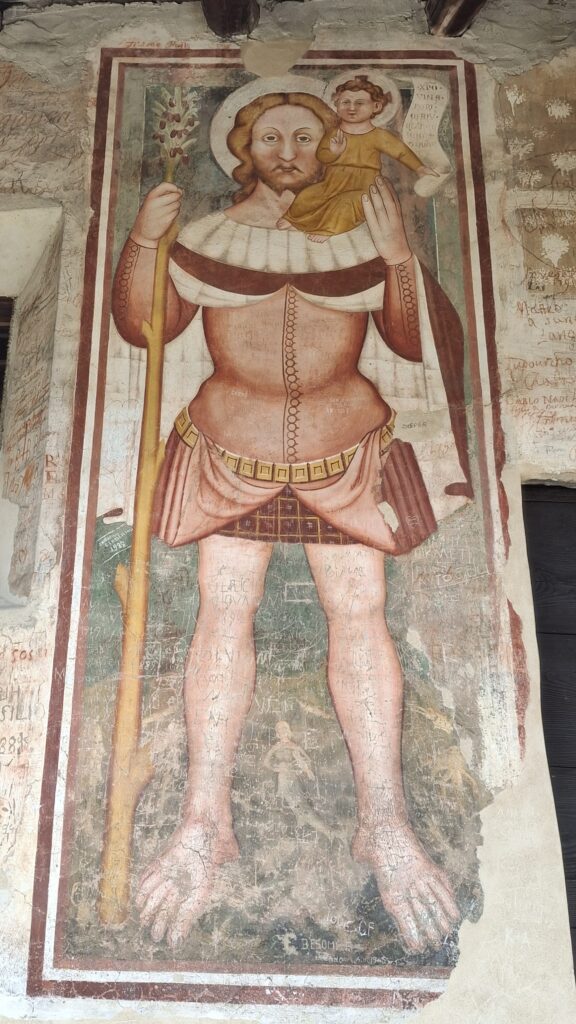
Saint Christopher between the Reformation and the Council of Trent
The 16th century is Saint Christopher’s terrible century. His cult is challenged first by the Humanists, then by Luther and the Protestants, and finally by the Catholic Counter-Reformation.

After the Council of Trent to the Present Day: 17th–21st Centuries
And yet the saint, no longer beloved by the Church, survives. Sometimes hidden, sometimes still publicly invoked — he lives on in the hearts of the faithful.
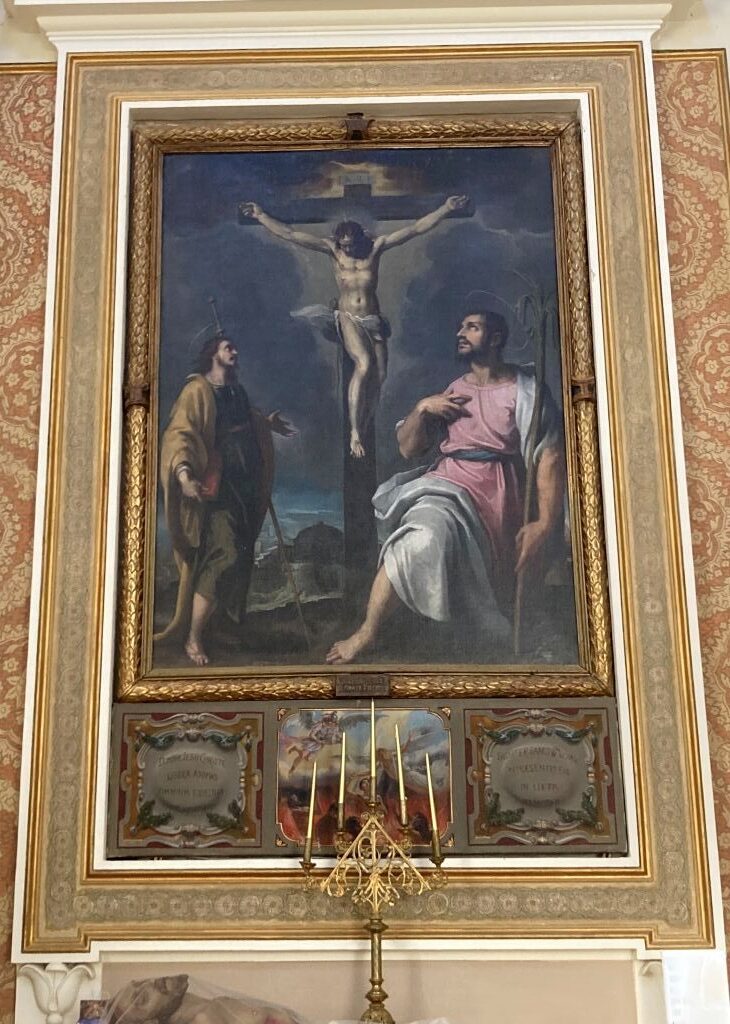
A New Fortune in the 20th Century
Patron of telegraph operators, he enjoyed a surge of popularity in the 1930s; in 1976 he officially became patron of motorists, though he had already been riding dashboards and dangling from keyrings for some forty years.

Painters and Sculptors of Saint Christopher
- Aliense
- Pomponio Amalteo
- Aleksander Augustynowicz
- Ansuino da Forlì
- Jacopo Bassano
- Claude Bassot
- Giovanni Bellini
- Bertolino de’ Grossi
- Paris Bordone
- Bono da Campione
- Bono da Ferrara
- Silvio Bottes
- Bernardino Campi
- Cavagna
- Cesare da Sesto
- Cima da Conegliano
- Cosmè Tura
- Lucas Cranach
- Giuseppe de Pigociis
- Francesco de Tatti
- Otto Dix
- Adam Elsheimer
- Gaudenzio Ferrari
- Giovanni Gudauner
- Giacomino d’Ivrea
- Limbourg Brothers
- Bernardino Luini
- Andrea Mantegna
- Mateo Perez Alesio
- Melchiorre d’Enrico
- Antonio Marinoni
- Juan Martínez Montañés
- Pellegrino di San Daniele
- Pietro da Vicenza
- Giovanni Battista Piazzetta
- Pordenone (Giovanni Antonio de’ Sacchis)
- Johann Georg Prunner
- Enea Salmeggia
- Eduard Sanfurgo Lira
- Stefano Veneziano
- Taddeo di Bartolo
- Jacopo Tintoretto
- Marco Tiussi
- Francesco Torbido
- Turone di Maxio
- Jan van Eyck
- Titian (Tiziano Vecellio)
- Antonio, Bartolomeo, and Alvise Vivarini
- Zenone Veronese
Saint Christopher by the Masters — on the YouTube channel Sulle spalle di san Cristoforo
In the history of art, Saint Christopher is a recurring subject, at times interpreted in a highly personal way. Let’s explore some of these artists’ own takes on the saint.
LUCAS CRANACH (1509)
TITIAN (1523)
LORENZO LOTTO (1531–1535)
JACOPO BASSANO (1556)
ADAM ELSHEIMER (1578)
OTTO DIX (1937–1944)