Opus Boni: the only signed work by Bono da Ferrara is the Saint Christopher
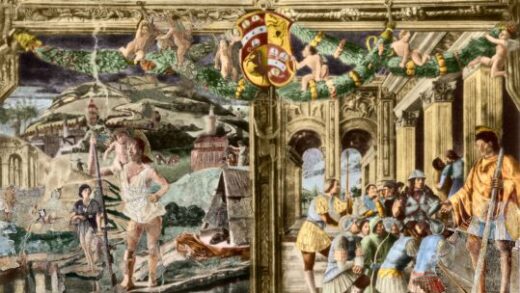
The only work signed by Bono da Ferrara is the Saint Christopher Carrying the Christ Child located in the Ovetari Chapel in the Church of the Eremitani in Padua. Bono worked on it alongside Ansuino da Forlì and Andrea Mantegna between 1448 and 1449. Beneath the fresco he inscribed, fittingly, opus Boni — the work of Bono.
Due to the events of 11 March 1944, very little of the fresco survives. However, using photographs taken before 1944, efforts have been made to reconstruct it through the careful restoration carried out in 2006.


Saint Christopher immersed in the landscape
The depiction of Christopher is interesting and quite distinctive. The scene is the familiar one described in the Golden Legend — the crossing — but the landscape is truly peculiar. It combines Piero della Francesca’s sense of space with a taste for detail rooted in the late Gothic tradition: on the hillsides, men and women go about their daily activities, not entirely distinguishable, especially the figures in the distance. Clearly visible, by contrast, is the figure of a woman heading to the stream carrying a bundle of laundry. Animals are also depicted: two fawns grazing on the grass. Several buildings punctuate the landscape, drawing on two distinct sources — the classical model of a small temple on the left (mirrored in the water in the foreground) and the contemporary image of walled hilltop towns (reflecting the taste for archaeological quotation typical of Mantegna and his master Squarcione). The hills are crossed by roads along which figures walk, amid woods and scattered trees.
Flashback: Saint Christopher and the hermit
In the background, to the right, an earlier scene is depicted. Christopher-Reprobus, towering in stature, speaks with the hermit, shown standing before a church. The hermit instructs the giant to settle by the river, in a hut, and take up the work of ferryman. The hut is shown to the right in the middle ground.
A Saint Christopher standing still on the shore, reflected in the water
The foreground scene is singular: Christopher has the Child on his shoulder but has not yet entered the water. Indeed, he appears rather static, standing still on the bank — and this creates a striking play of reflections on the surface. The water is motionless: the scene almost seems to unfold on the shores of a lake or the still waters of a lagoon, evoking the landscapes of Ferrara or Venice.

The saint’s appearance is also unusual: he wears a very short tunic, with no cloak (is he leaning against the hut?). He leans on a staff topped with a strange kind of pinecone or plume. Though long-haired, he is clean-shaven, and his wide-eyed face bears the features of certain figures rendered in an expressionist manner by Andrea del Castagno. The Christ Child, oddly resting on the right shoulder, holds in his hands a small staff topped with the globe of the world (though here fashioned with two discs, one above and one below).
Above, the garlands — in the Squarcionesque style, executed by Nicolò Pizzolo — with fish, leaves, fruit and putti frame the scene and connect it to the one that follows.
Saint Christopher, a saint on Earth
Traditional and new elements combine in this depiction in the Ovetari Chapel: in Bono’s work one senses a search for a different way of portraying the saint, placing him in clear relation to the landscape — and thus to everyday life. A saint not in paradise, but on earth, among ordinary people like himself.
The sacred and colossal Saint Christopher of Mantegna
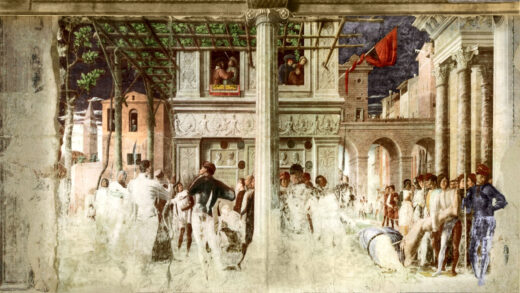
Far more monumental and sacred, by contrast, is the rendering of the Martyrdom scene, painted by Mantegna in the lower panels some years later.

On the Ovetari Chapel
Bibliography
- Catalogo generale dei beni culturali
- On Bono da Ferrara: Treccani e Wikipedia