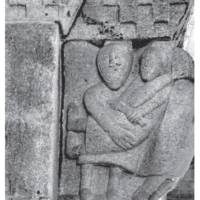
In the district of Porto, in Vila do Conde, stands the Church of São Cristóvão de Rio Mau, a Romanesque building classified as a National Monument since 1910. Among its stones it holds something extraordinary: a capital that may be one of the oldest known depictions of Saint Christopher carrying the Christ Child.
Among its stones, it preserves something extraordinary: a capital that could be one of the oldest known depictions of Saint Christopher carrying the Child Jesus. It would be contemporary with the capital of San Jacopo in Porticaia, which we have already talked about in a previous post.
São Cristóvão of Rio Mau: Portugal’s Forgotten Romanesque Gem
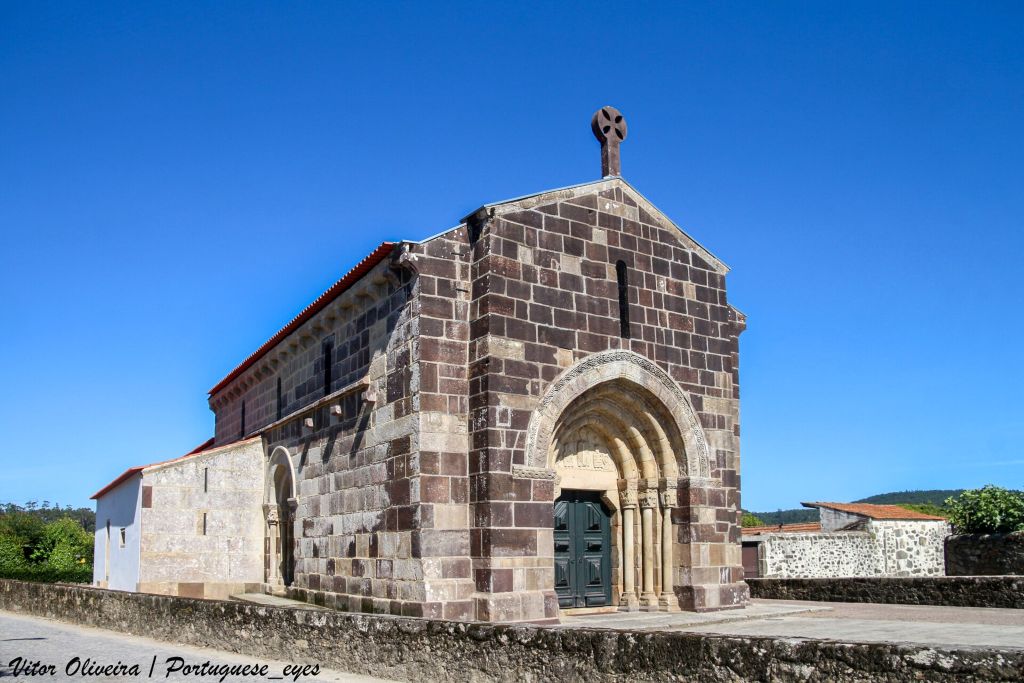
The church is all that remains of an ancient monastery founded in the 11th century by the Canons Regular of Saint Augustine. The first written mention dates to 1103, but the foundation is probably even older; Bishop Peter (1085–1089) cites it with the dedication of Sancto Christoforo de Ribulo Malo. We then have an inscription from 1151, to which we will return. In 1443 the monastery was suppressed and its assets passed to the nearby abbey of São Simão da Junqueira. The conventual outbuildings were demolished; fortunately the small church survived, and today we find it almost intact.
The Architecture: Simplicity and Mastery
The building is pure Romanesque: a single nave with a wooden roof and a vaulted rectangular apse. The structure is sober, even austere. But it is precisely in this contrast between the simplicity of the nave and the decorative richness of the apse that the monument’s charm lies. The reconstruction of the apse began in 1151 — as attested by an inscription still visible today — and reveals a very strong influence of Galician art, in particular the school of Tui.
The Portals: A Book of Stone
The most fascinating part of the church is its portals, which tell stories through images with the force typical of medieval iconography.
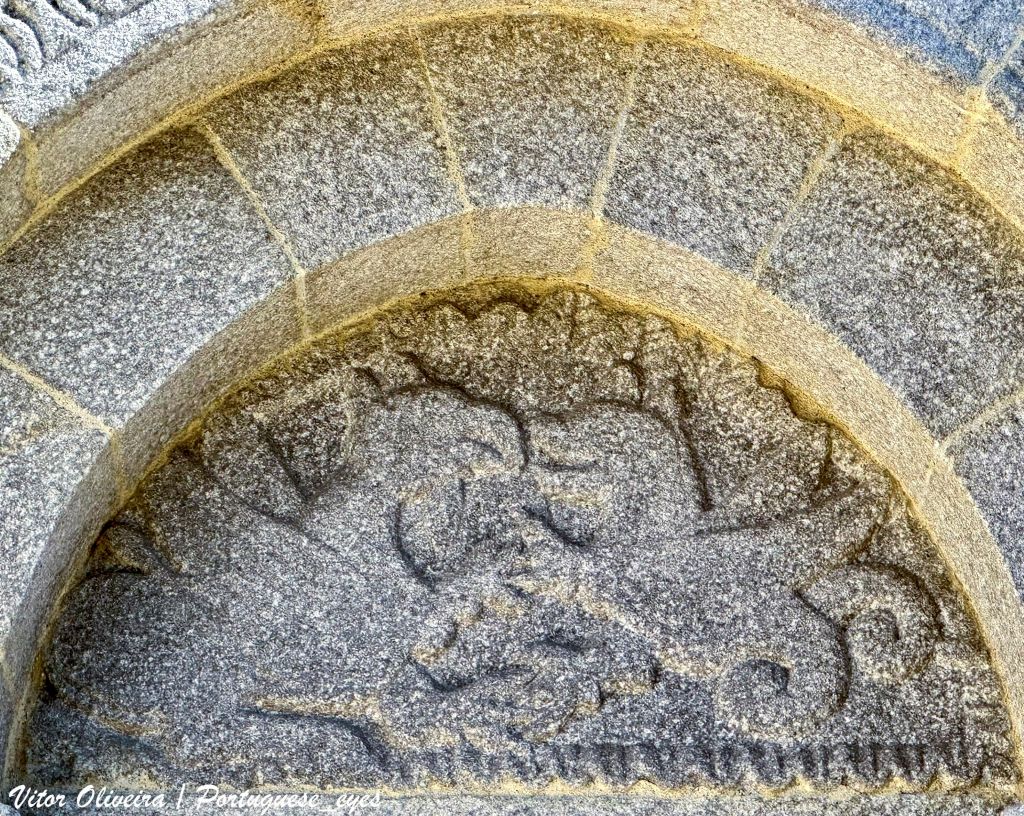
The north lateral portal features a tympanum with a dragon and a griffin facing each other: a symbol of the eternal struggle between good and evil, between Christ and the devil.
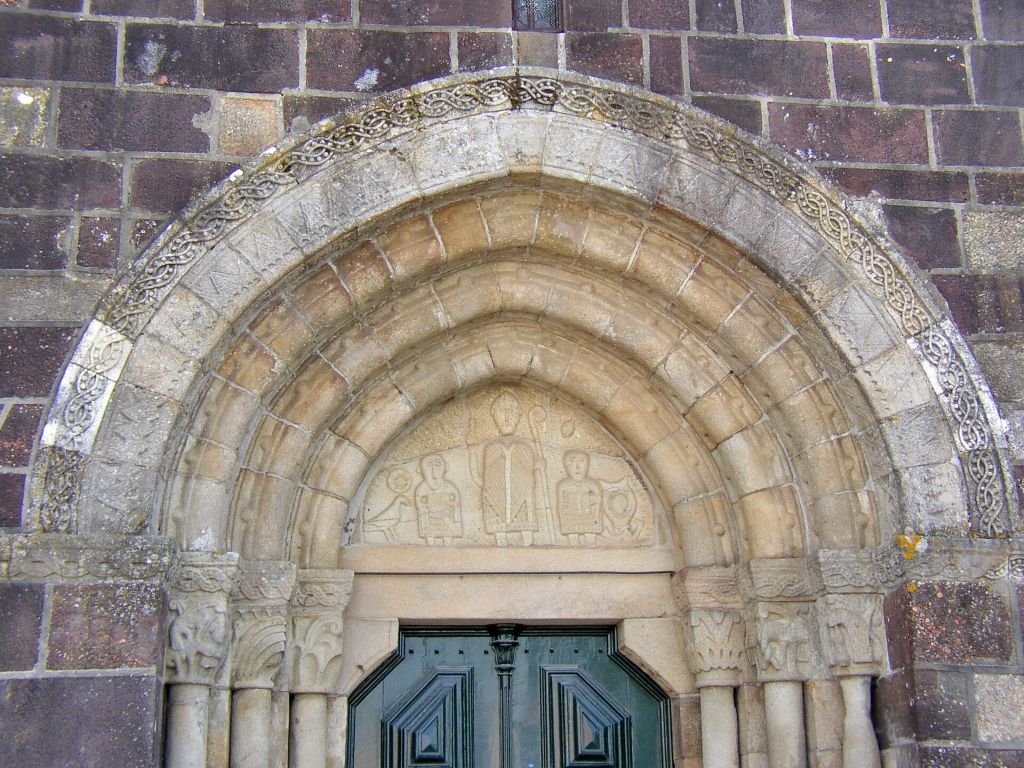
The main portal is even more elaborate: at its centre stands a bishop in a blessing gesture — almost certainly Saint Augustine — flanked by two deacons. On either side, a bird with the sun and a siren holding the moon complete the scene, with all the Augustinian symbolism these elements carry.
The Mysterious Capitals of the Main Chapel
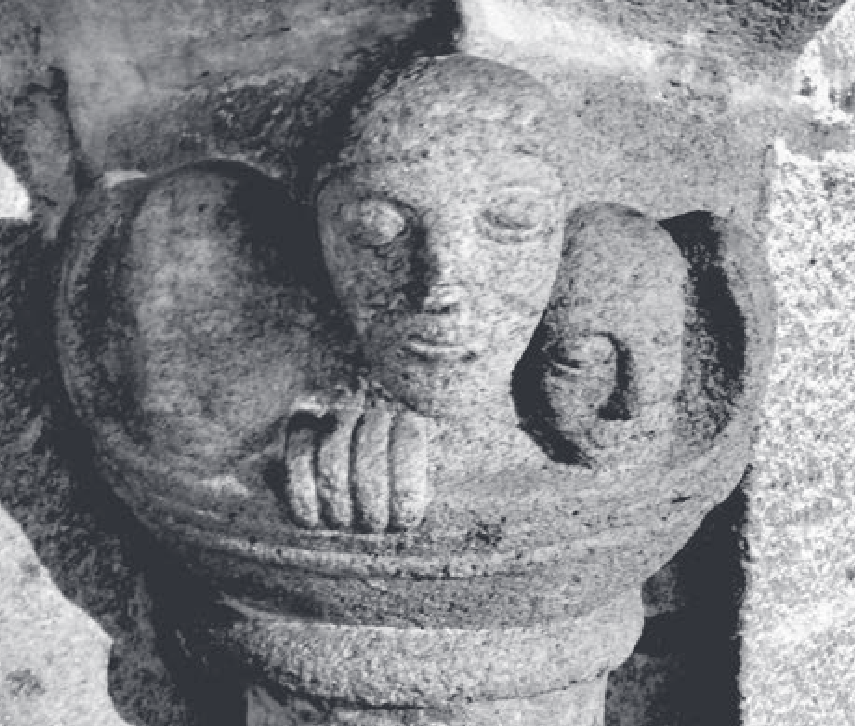
Yet even more interesting for us are the capitals of the main chapel, in particular a capital with three sculpted faces.
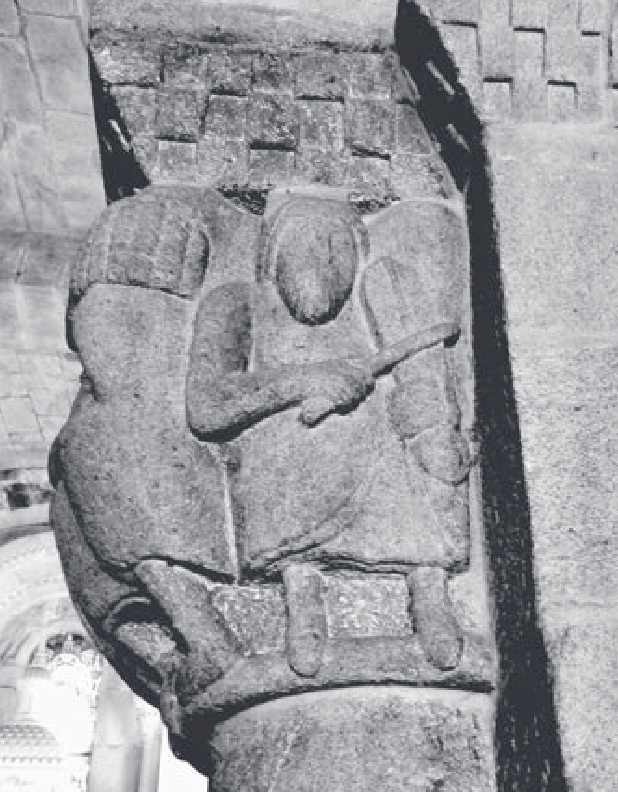
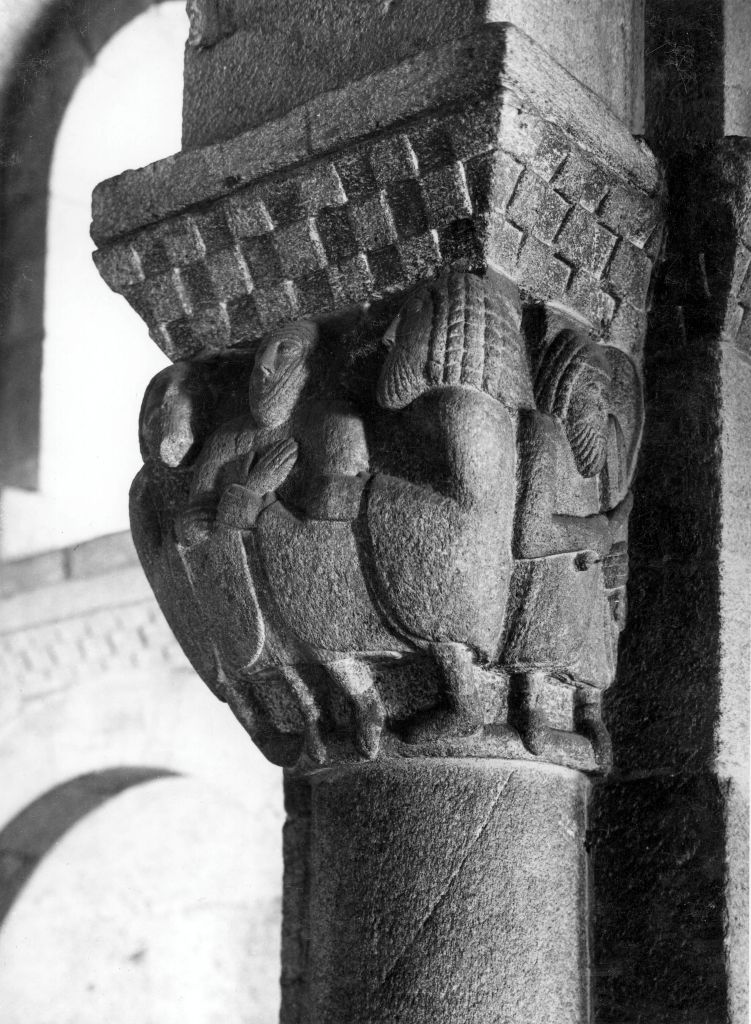
The most celebrated image is that on the south side of the triumphal arch. On the face turned toward the congregation, a bearded figure plays a bowed string instrument — a medieval viol — in the unmistakable pose of a jongleur, the itinerant storyteller who spread legends and chivalric romances.
On the central face, two figures hold by the arms a third character who rests his hands on his chest, in a pose that evokes that of a corpse.
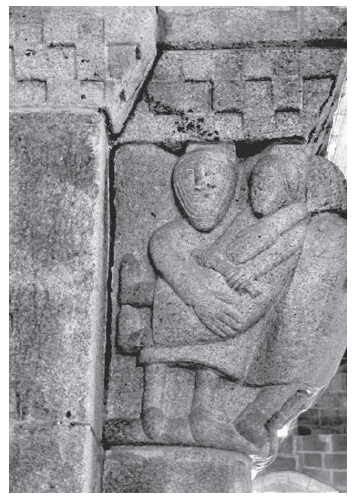
On the face toward the altar, finally, a man gently supports a figure wrapped in cloth.
Alongside these figurative scenes, the other capitals display plant and animal motifs of great refinement, with decorative friezes and modillions.
What strikes you, standing before these hand-carved granite blocks, is the awareness that these sculptors were not mere craftsmen: they knew the iconographic tradition of their time, were in dialogue with Galician and Portuguese workshops, and knew how to tell a story in a few centimetres of stone.
A Death and a Lamentation?
What interpretation should we give, then? Many scholars read in them a sequential narrative — perhaps a scene of death and lamentation drawn from the oral repertoire of the time — told with a sobriety that does not exclude emotion. Yet other readings of the capitals have been proposed, very interesting for our purposes.
Saint Christopher: Uncommon Images
A Strange Ferryman
The sculpted scene shows a man holding another in his arms. This image has been linked by scholars, as early as Porter in 1928 (a hypothesis later revived by Rosenfeld in 1937, by Almeida in 1986, and extensively discussed by Rosas), to Saint Christopher, the patron of the church. The first peculiarity that catches the eye is that the saint is not carrying the Child we are accustomed to seeing in later images. Here Jesus appears as an adult, supported not on the saint’s shoulder (as would become canonical after the Legenda Aurea), but in his arms.
Further details enrich the scene: the saint wears a helmet, a reference to his origins as a soldier-martyr, while Christ holds in both hands a rod — a symbol, according to historian Carlos Alberto Ferreira de Almeida, of his divine authority and royal power over the world.
Saint Christopher Carries the Adult Christ
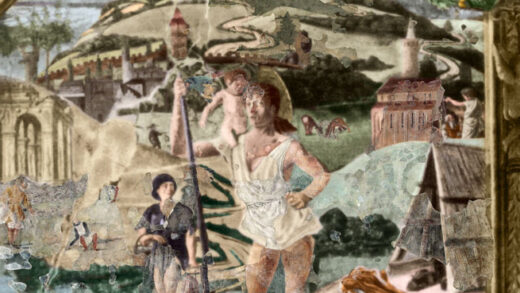
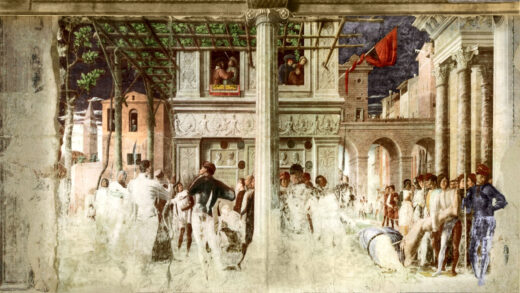
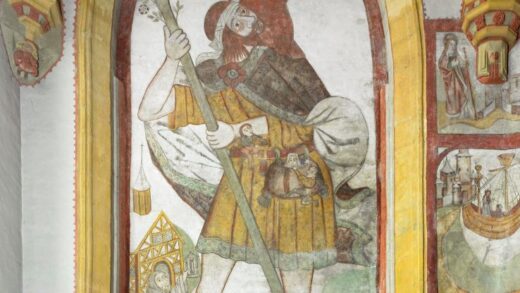
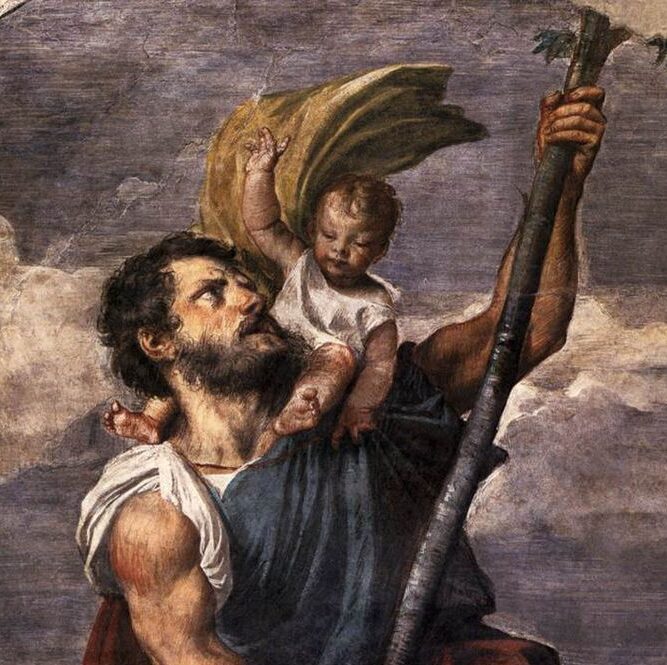
An iconography, then, very different from the one we are used to, and for this reason the saint went unrecognised for a long time. But the peculiarities of the saint have a precise reason: this capital was carved before the Legenda Aurea. And it was the Legenda Aurea that consecrated Saint Christopher as the bearer of the Christ Child. But it was not always so: indeed, throughout the 13th and 14th centuries there are also other images of Saint Christopher carrying the adult Christ in his arms (as in Taufers in Münstertal, in South Tyrol) or with the Child resting on his arm, as in representations from England and Wales.

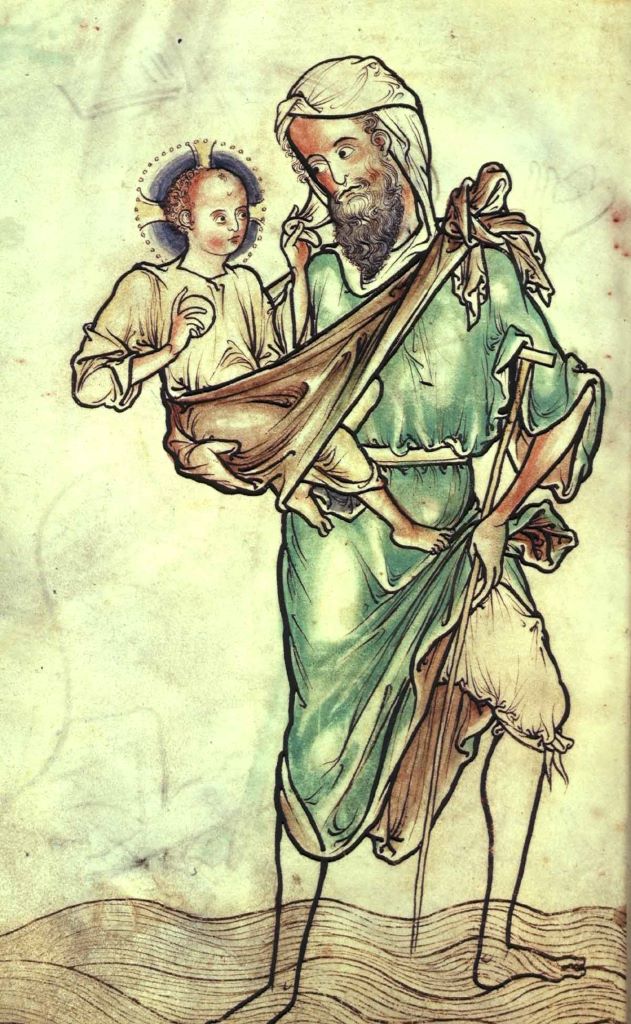
The church of Saint Christopher at Rio Mau, from the 11th century, may therefore hold one of the oldest prototypes in the world of this depiction.
The other capitals of the main chapel may also refer to the story of the saint.
A Jongleur Playing the Viol
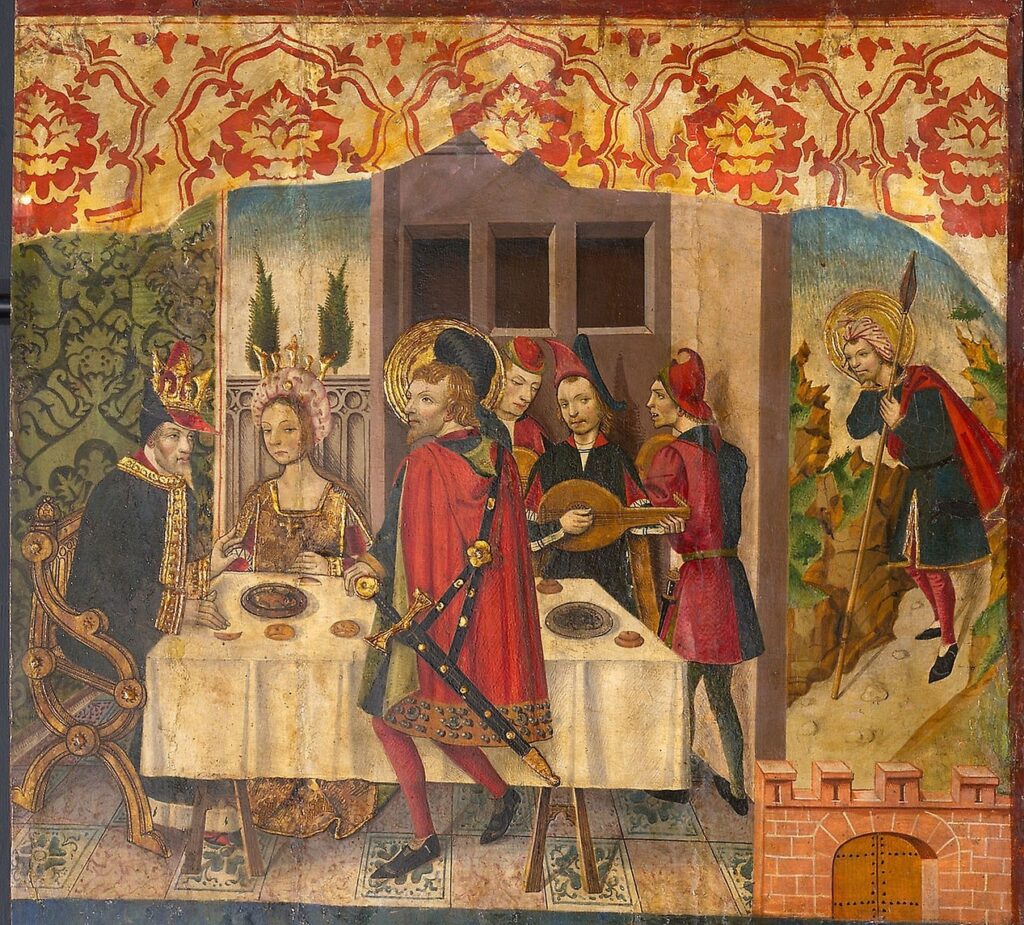
The capital on the south side of the triumphal arch thus features a jongleur intent on playing a viol. Perhaps this is not a simple courtly scene, but a reference to an episode in the life of the saint. While the saint is still at the king’s court, a jongleur sings a song about the devil and the king is frightened. From this moment, Reprobus-Christopher decides to go in search of the devil, believing him to be the most powerful lord in the world. The same scene is painted in the 15th century by Martín de Soria: and yet here too is the image of a jongleur playing the viol.
There may also be a reference here to an episode from the Latin Passio of the saint (BHL 1764): while soldiers attempt to arrest the saint, a miracle of the multiplication of loaves occurs. Saint Christopher then intones psalms of thanksgiving. Is the capital therefore depicting Christopher singing psalms to the viol?
The Arrest of Saint Christopher
The neighbouring capital would also relate to the story of Saint Christopher: it would portray his capture.
The saint finds himself at the mercy of three soldiers and clutches his own wrist — a gesture of helpless pain typical of Romanesque sensibility — while being dragged toward martyrdom. Incidentally, the same image of a man grasping his wrist appears in other Iberian churches dedicated to the saint (in Burgos and Segovia).
Among the most mysterious details of the capital is also the helmet. It can be interpreted as one of the instruments of torture used against Christopher: the sculpture renders it with small triangles evoking flames, bearing witness to the tortures he endured.
The iconographic theme of Saint Christopher would allow us to give meaning to two other capitals of the chapel as well: one depicts a lion threatening the very man who carries another in his arms, while the other capital shows a boat with three figures.
The Struggle Between the Saint and the Devil
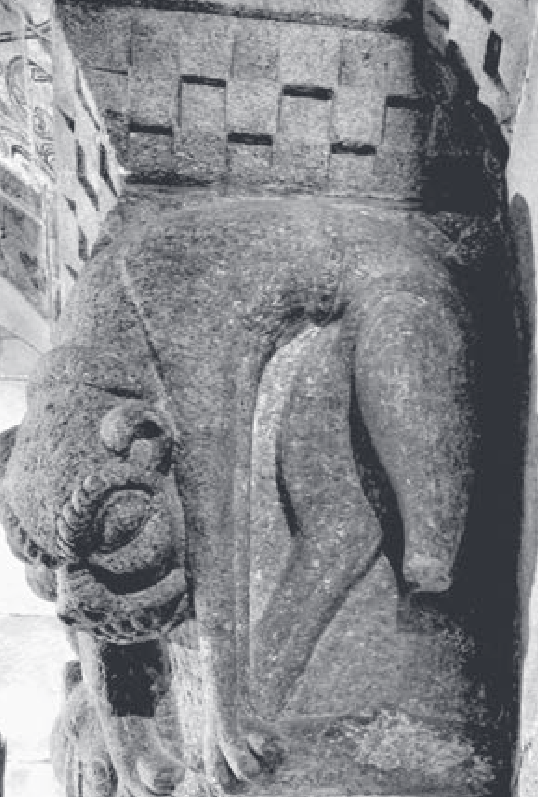
Directly above Saint Christopher is the lion that challenges the saint with an aggressive air: it is interpreted as the devil against whom Saint Christopher struggles, and in general, against whom every holy martyr fights.
The “Evil River” and the Founder
And finally, on the capitals of the south wall a boat with three figures appears, a direct reference to the protection the saint offered against floods. This detail, present in a Latin passio, is connected to the fact that the presence of the martyr’s tomb saved the city in which he was buried from a flood and protected it forever. The place where the Portuguese church stands had to do with a turbulent river, as can be gathered from the place name Ribulo Malo — literally “evil river.”
The Irish Passio of the saint ends similarly:
However a certain Peter gave a price for the body of Christopher, and took it with him to his city. There was a stream which damaged the city, and the body was buried facing the onset of the stream, and after that the stream did no more harm to the city.
It is interesting to note another aspect: the name of the priest who buried Christopher’s body — Peter. This allows us to illuminate the meaning of the inscription in the church in a different way.
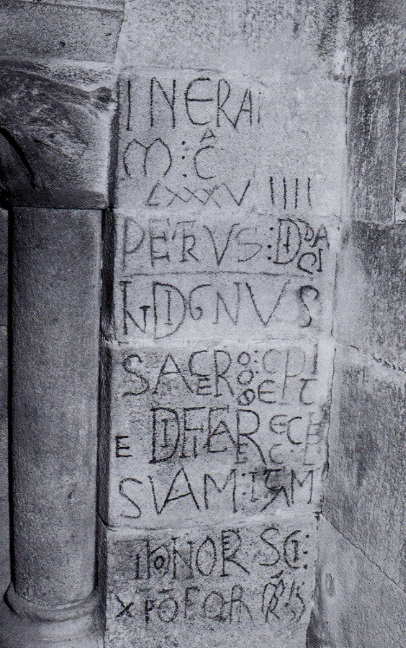
The inscription, transcribed by Carlos Alberto Ferreira de Almeida, reads:
In Era / M Ca LXXXVIIII / PETRUS DIDACI INDIGNUS / SACERDOS CEPIT / EDIFICARE ECCLE / SIAM ISTAM / In HONORE(m) S(an)C(t)I / XPOtoFORI MartyRIS
Peter Dias, then, calls himself an “unworthy priest.” Yet perhaps in him at least two symbolic layers were at play. There is a Peter who in the Irish legends recovers the saint’s relics, and there is a presbiter Petrus who in the Latin Passio baptises Christopher. By founding the church, Pedro Dias seems to wish to embody both — the one who introduces the cult into Portuguese territory and the one who, through the image, protects the community from floods.
Other Interpretations
The reconstruction by scholars, reorganised and consolidated by Lúcia Rosas, seems convincing, although considerable doubts remain. Other hypotheses have been put forward, as reported in the Pesquisa entry.
From an episode of the Chanson de Roland, to the evocation of Saint Christopher, passing through an allusion to a Viking attack (RODRIGUES, 1995, p. 275) or to the disaster of Badajoz under D. Afonso Henriques (OLIVEIRA, 1964), it has not yet been possible to reach a consensus and, equally importantly, a reading that forms part of the broader iconographic whole.
All of this, far from disappointing us, makes truly fascinating the path of historical study that allows us to enjoy genuine masterpieces.
I close with a photograph of the church from 1918.
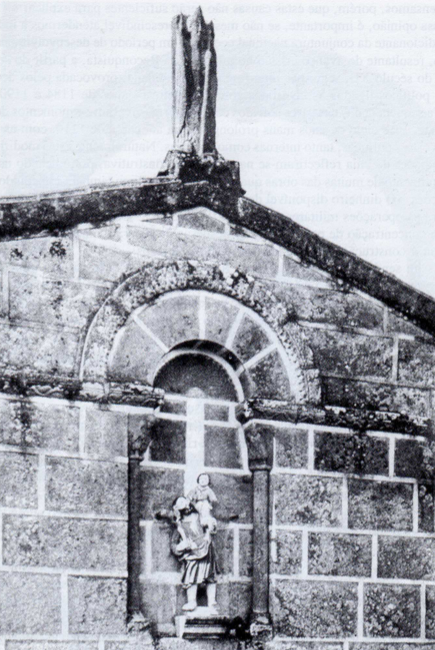
On the façade, beneath the statue of Saint Augustine, stands a statue of Saint Christopher. Is it perhaps the same one that is still carried in procession today on the occasion of the patronal feast of Saint Christopher, patron of Rio Mau in Vila do Conde?
Bibliography
First of all, the text guiding me on this journey.
Rosas, Lúcia. 2016. «PASSIO CHRISTOFORI: A LENDA DE S. CRISTÓVÃO NA IGREJA DE RIO MAU VILA DO CONDE». Genius Loci: lugares e significados = places and meanings. Vol.1 1
And now the others
- Costa, Marisa. 1985. «A_Igreja_de_Sao_Cristovao_de_Rio_Mau». Boletim cultural da camaara municipal de Vial do Conde, fasc. 15/16 (dicembre).
- Rosas, Lúcia. 2016. «PASSIO CHRISTOFORI: A LENDA DE S. CRISTÓVÃO NA IGREJA DE RIO MAU VILA DO CONDE». Genius Loci: lugares e significados = places and meanings. Vol.1 1.
- Sousa, Luís Correia de. 2005. «Iconografia musical na escultura Românica em Portugal». Medievalista. Online, fasc. 1 (gennaio). https://doi.org/10.4000/medievalista.920.
- RODRIGUES, Jorge, 1995, “O mundo românico (séculos XI-XIII)”, História da Arte Portuguesa, vol.1, Lisboa, Círculo de Leitores, 1995, pp.180-331
- OLIVEIRA, António de Sousa (Júnior) Um passo da história portuguesa num capitel românico”, Bracara Augusta, vol. 16-17, pp.149-155
- ROSENFELD, Hans-Friedrich. 1937. Der hl. Christophorus, seine verehrung und seine legende: Eine untersuchung zur kultgeographie und legendenbildung des mittelalters. Åbo akademi.