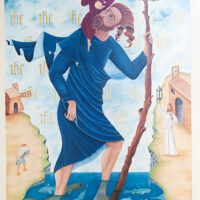
Saint Christopher from Buxheim (Southern Germany) to Llanynys (North-East Wales)
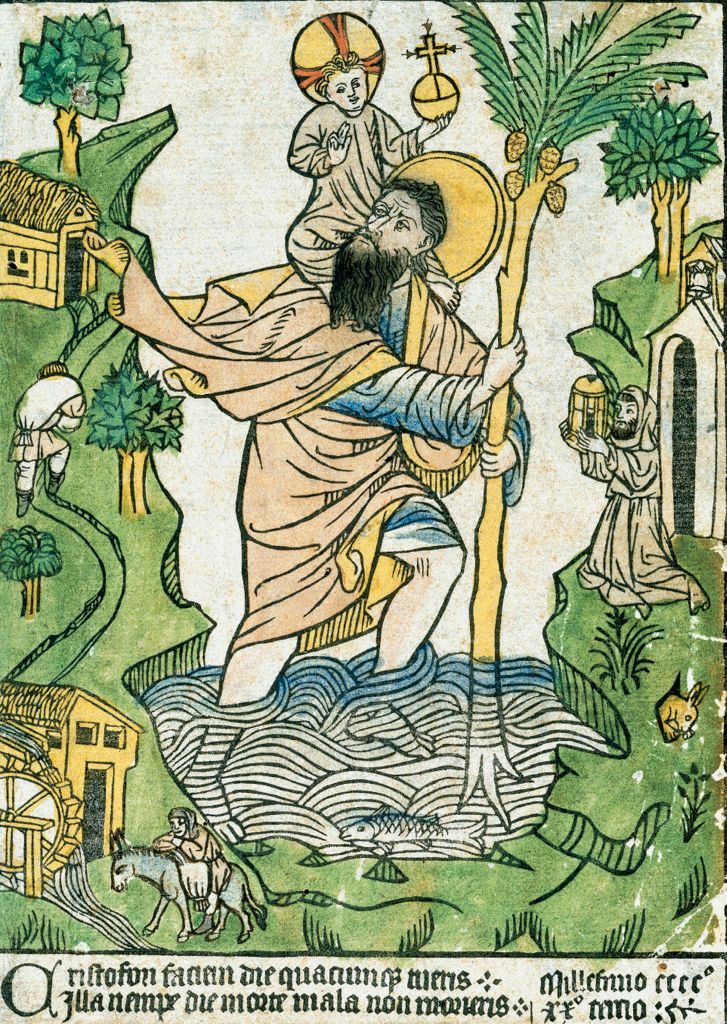
It was certainly the Buxheim woodcut that inspired the Welsh painter of St Saeran’s Church in Llanynys, Denbighshire, to create his fine Saint Christopher.
Yet look closely at the saint’s feet. From the little fish of a river in Southern Germany to the abundant, dangerous marine life of coastal Wales!

Saint Christopher: from Buxheim…
In the Carthusian monastery of Buxheim, near Memmingen in Southern Germany, a manuscript of the Laus Mariae was donated in the 15th century. On the manuscript’s cover was a woodcut depicting Saint Christopher: the story behind this woodcut is so fascinating that we’ll tell it in another post.
…to Llanynys (in the county of Sir Ddinbych – Denbighshire)
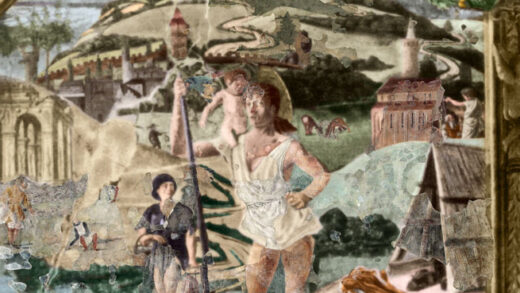
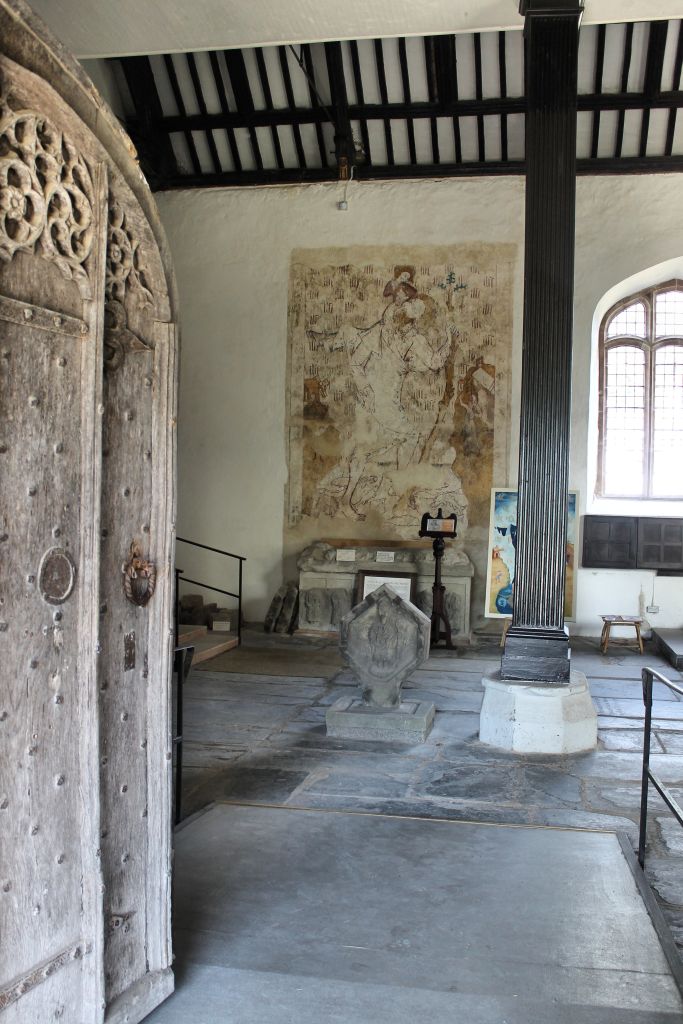
A copy of this woodcut certainly reached Llanynys, and the fresco painter drew on it to create a colossal version, at least three metres tall, still visible today on the south wall of St Saeran’s Church (though in a rather precarious state of preservation).

Two similar images
Setting aside size and medium, the resemblance between the two images is striking. Saint Christopher crosses the water making the same gesture: one knee bent and raised, his face turned back to look at the Child, a long beard framing the saint’s features. Even though the cloak appears to be made of a different fabric, its billowing shape is the same in both.
The Welsh landscape draws on that of the Buxheim engraving: behind the saint a mill can be glimpsed, while on the far bank a hermit lights the way with a lantern.
The differences: staff and fish
The saint’s staff
Christopher leans on his staff, but this is where the first significant differences appear: the German Christopher holds a whole tree, roots and all (as is typical in German depictions), ending in palm leaves and dates. The Welsh staff is far more gnarled and ends in three strange leaves.
The marine life
The Llanynys image appears to have been cropped (and it lacks the inscription describing the saint’s miraculous powers). The river has no closing line at the bottom, so we too are plunged, like the saint, into the water. And here we come to the heart of the matter: the marine life between the saint’s legs is remarkably abundant and lifelike.

A ray, a dolphin, a swordfish, a catfish, a shell, a sea serpent, and other fish I can’t identify crowd the water and hinder the saint’s progress. This is very much an addition by the Welsh fresco painter, following the typically English and Welsh convention for depicting the saint.
The marine life in Saint Christophers across England and Wales
This marine life appears in virtually all medieval and Renaissance depictions of Saint Christopher on the island. At Pickering, for example, a sort of dragon coils right around the saint’s foot, while another sea creature threatens his left leg, the one bearing his weight. Sin — or the Devil himself — is trying to halt Christopher’s crossing.
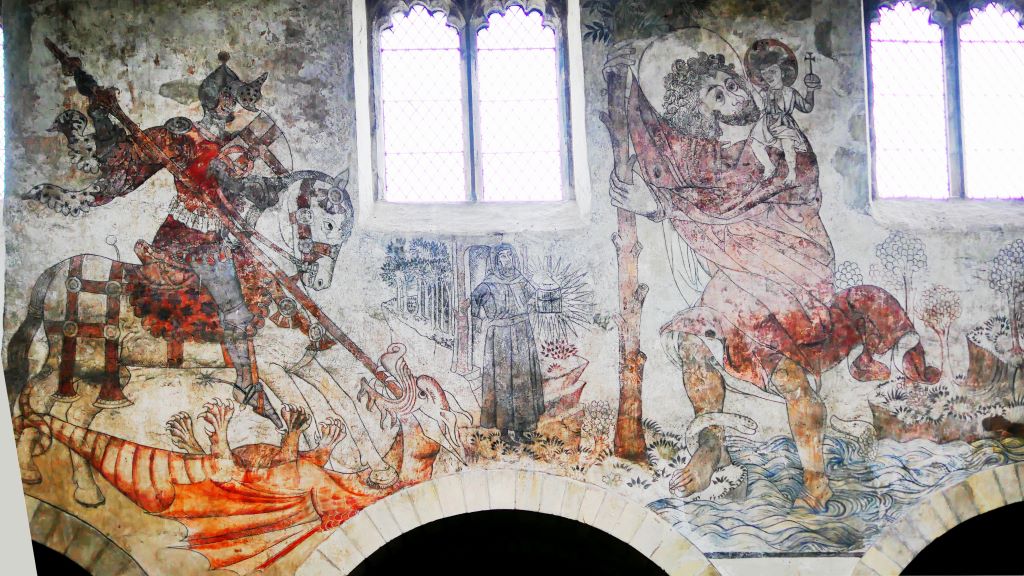
This detailed, prominent marine life is truly paradoxical: scholars (notably Pidgeon) have shown that in Wales, Saint Christopher has nothing to do with protection over water or the crossing of rivers (or seas).
The symbolic value of the fauna: fish, serpents and the mermaid
The fauna thus takes on two contrasting roles: while its depiction is highly realistic — drawing on the marine life most readily associated with Wales — its meaning is deeply symbolic, representing the monsters that try to block the saint’s path of redemption. This allegorical intent is especially clear in the Saint Christopher at Oaksey, where a mermaid sits at his feet combing her hair while admiring herself in a mirror: vanity standing in the way of conversion.

The saint has already trodden on a serpent, but other fish continue to block his way. Still others have been caught and appear tied to a net, perhaps held by a fisherman (of whom only the rod and line are visible). So many obstacles — yet the saint presses on with his nighttime crossing (note the stars in the sky!).
From the global Buxheim to the local Llanynys
So, returning to our fresco painter in Llanynys, we have a perfect example of how a “global” image — the Buxheim engraving, which enjoyed enormous popularity — became a truly “local” one, thoroughly Welsh in character.
Bibliografia
- StSaeran’s Church
- Medieval Wall Painting in the English Parish Church: Pickering:, Oaksey
- Eleanor Elizabeth Pridgeon, per l’University of Leicester, 2008. Saint Christopher Wall Paintings in English and Welsh Churches c.1250-c.1500,