The Story of a Bombing
The Ovetari Chapel is destroyed!
March 11, 1944: Allied bombs severely damage the Church of the Eremitani in Padua. The chapel in the right nave — known as the Ovetari Chapel after its patron — is hit by a bomb meant to strike a barracks, or perhaps the train station.
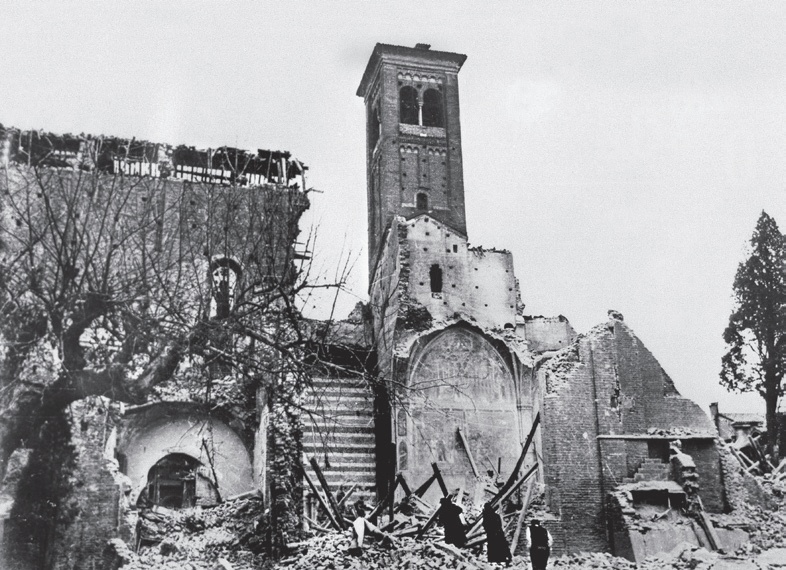
The chapel frescoed by Mantegna, Ansuino da Forlì, and Bono da Ferrara is blown to pieces. The fragments are collected in the hope that one day the frescoes might be reassembled.
Lucky for us…
Lucky for us: photographic documentation exists.
Lucky for us: copies of the works had already been made.
Lucky for us, above all: Mantegna’s Martyrdom and Transport of the Body of Saint Christopher are not on the wall at the time of the bombing. They had already been moved for restoration in 1880; during the war they are kept in the Basilica del Santo, which is left undamaged.
For the frescoes by Bono and Ansuino, and for Mantegna’s scenes from the Life of Saint James, there is unfortunately little to be done. The fragments are gathered into forty boxes. Only in 2006, using some of the most advanced restoration techniques available, is what was destroyed partially rebuilt. Here is what there was before, and what there is now.
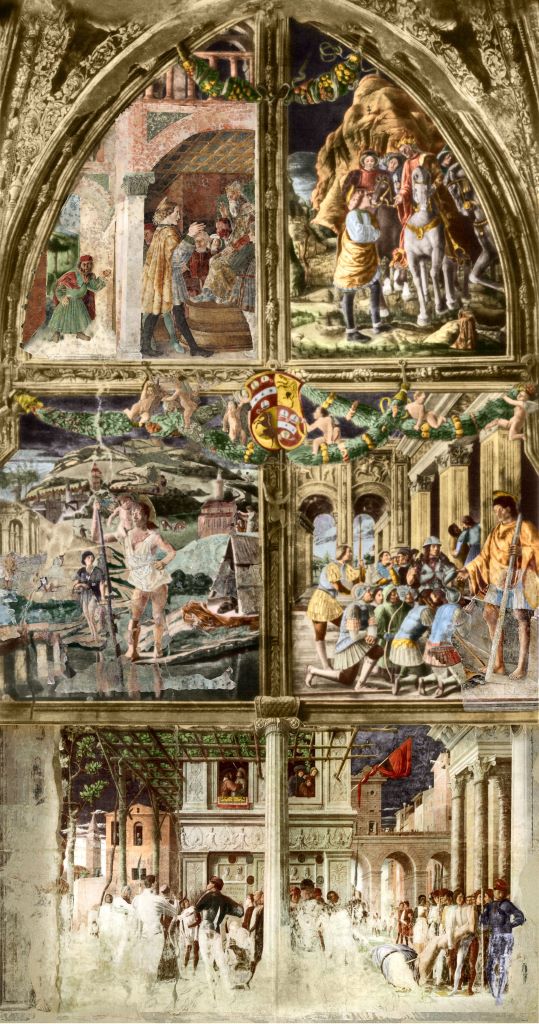
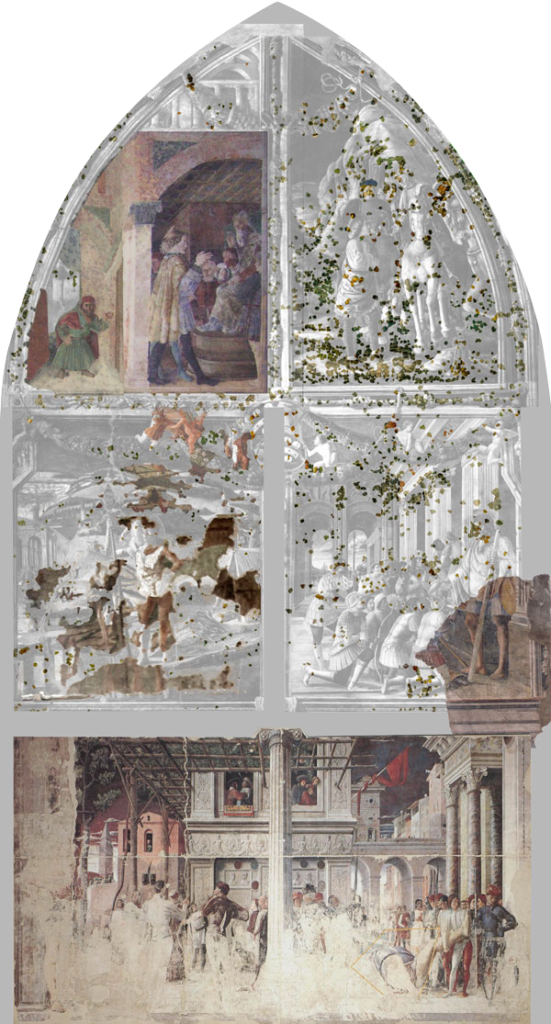
Let’s uncover the fascinating story of how the Chapel was decorated!
The Story of a Chapel’s Decoration
A bequest and two workshops
Let’s hop in a time machine and go back to 1448. Imperatrice Ovetari, widow of the notary Antonio, has a substantial sum — left to her by her husband — to decorate the family chapel in the Church of the Eremitani in Padua. The family had deep ties to a place of hospitality and care dedicated to Saints James and Christopher.
She decides to commission two very different workshops.
The first is the Venetian workshop of the Vivarini — established, traditional painters. Antonio Vivarini and his brother-in-law Giovanni d’Alemagna come to Padua, tasked with painting the stories of Saint Christopher.
The second is the Paduan workshop of Squarcione: two young painters arrive, Niccolò Pizzolo and Andrea Mantegna, who are to paint the stories of Saint James.
A titanic undertaking — full of quarrels, lawsuits, deaths, and money trouble
First lawsuit: 1449
Niccolò Pizzolo is thoroughly fed up with Mantegna, who keeps interfering with his work. He takes him to court, and Andrea Mantegna downs tools.
First death: 1450
Giovanni d’Alemagna dies, and Antonio Vivarini also withdraws from the commission. They are replaced by painters closer to the style of Piero della Francesca: Bono da Ferrara and Ansuino da Forlì.
Money trouble: 1451–1453
The funds run dry. Work comes to a halt.
Second death: 1453
Niccolò Pizzolo also dies. And so Mantegna, working alone, completes the decoration of the entire chapel, adding two more scenes to the Saint Christopher wall as well.
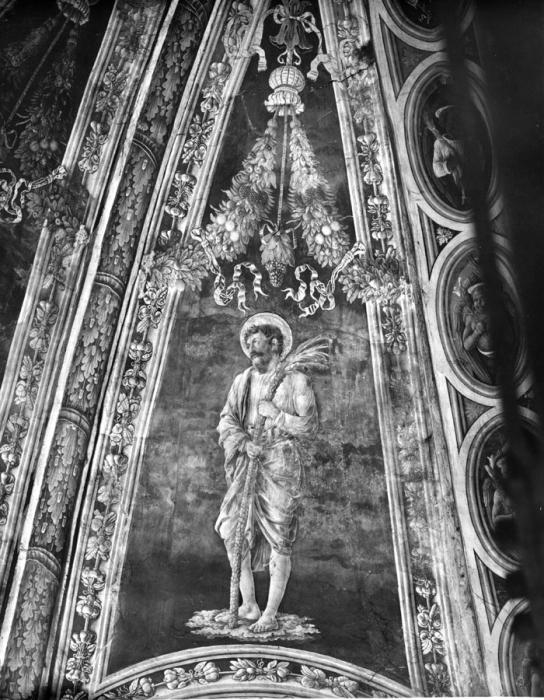
Second lawsuit: 1457
“How many apostles are there, Mr. Mantegna?” “Twelve, my lady Imperatrice.” “Then why have you only painted eight? I’m not paying you.” “I painted eight because there’s only room for eight!” “Well, you know what? I’ll see you in court.”
A mission accomplished
And yet, against all odds, the titanic undertaking succeeds… at least until World War Two.
The Stories of Saint Christopher
At last, let’s look at the frescoes. They tell the story of Saint Christopher as found in the Golden Legend. (In this post I describe each fresco individually; I’ve dedicated separate posts to the full story as told in the Golden Legend, and to the works by Bono da Ferrara and Andrea Mantegna. Cycles depicting the life of Saint Christopher can also be found in other churches.)
First panel, painted by Ansuino da Forlì

Reprobus-Christopher is a mighty young man of great means with a single desire: to serve the most powerful king in the world. But the Devil is already knocking at the door, as if to warn Reprobus-Christopher that he is the mightiest lord on earth.
Second panel, painted by Ansuino da Forlì

Saint Christopher meets the king of demons – Ansuino da Forlì – Ovetari Chapel – Church of the Eremitani – Padua
Reprobus-Christopher offers his services to the king of the devils.
Third panel, painted by Bono da Ferrara

Christopher carries the Child across the river, staff in hand.
Fourth panel, painted by Ansuino da Forlì

The Preaching of Saint Christopher – Ansuino da Forlì – Ovetari Chapel – Church of the Eremitani – Padua
Christopher preaches at Samos in a pagan temple, and converts the soldiers, who kneel before him.
Fifth and sixth panels, painted by Andrea Mantegna
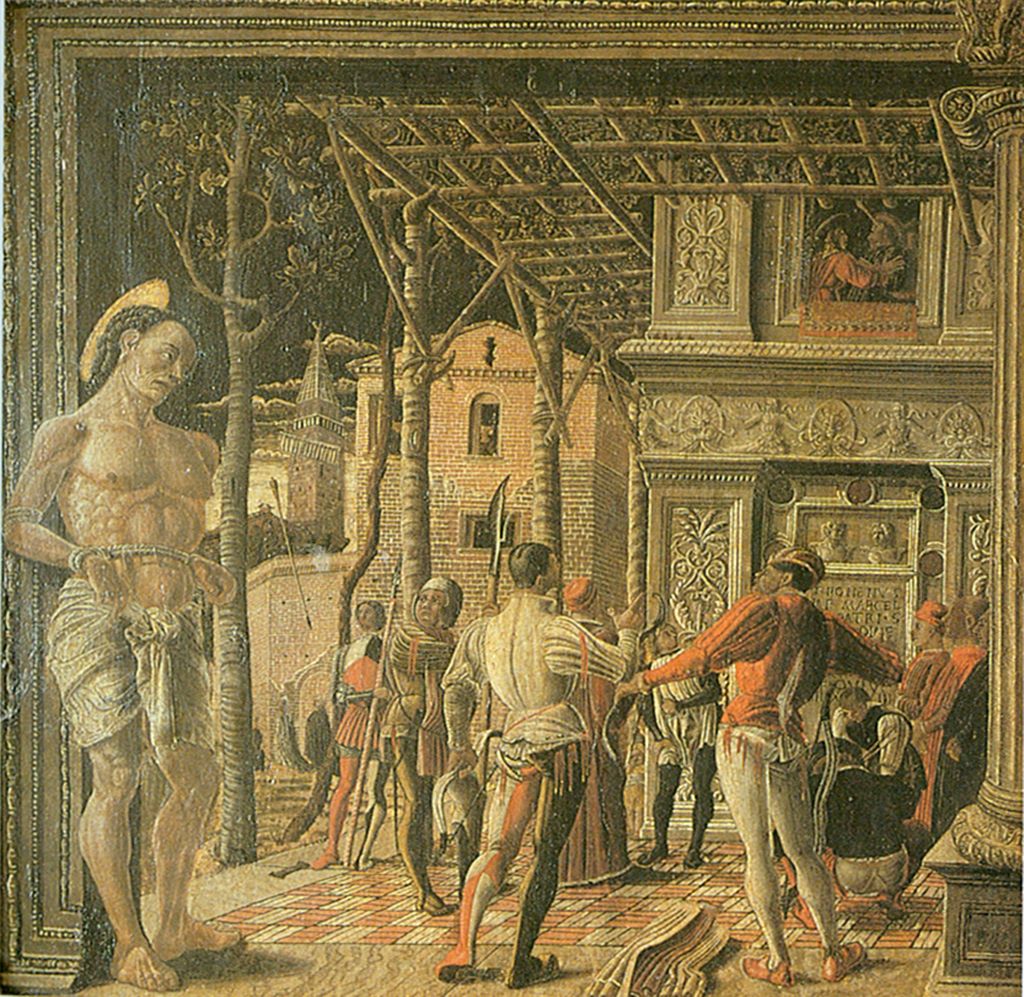
King Dagnus has ordered Christopher’s execution, but the arrows fired by the archers fly back toward the bowmen. One of those arrows strikes the king himself in the eye — he is watching from a window of his palace. Saint Christopher stands unharmed, a colossus leaning against the wall on the left.
Martyrdom of Saint Christopher – Andrea Mantegna – Ovetari Chapel – Church of the Eremitani – Padua
On the other side of the column, the action continues: the Saint’s decapitated body is carried away. The king, healed by the martyr’s blood, watches the scene once more from the window of his palace.

The Story of a Visit to Padua
As I stand looking at the walls of the Chapel, I think about the fresco fragments that have yet to find their place, and I wonder: will there ever be an artificial intelligence capable of putting them back together? Let’s hope technology keeps advancing — but above all, let’s hope that in the future there will be no more need to piece together the fragments of bombed places. Not because bombs have grown smarter, but because people have learned to stop settling their disputes with them.
On the Ovetari Chapel
Bibliography
- Wikipedia – Ovetari Chapel
- Fresco reconstruction
- Archivio Luce: original photographs and footage of the bombing of Padua