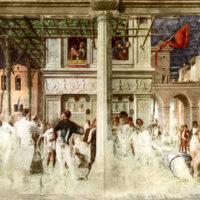
When Mantegna Arrives, When Mantegna Leaves
Andrea Mantegna comes to Padua to work on the Ovetari Chapel in the Church of the Eremitani: he is only seventeen years old and follows the teachings of his master, the antiquarian painter Francesco Squarcione. By the time he completes the decoration of the Chapel, he is twenty-six, has married Nicolosa Bellini (sister of the Venetian painter Giovanni Bellini), and already has an original and mature style of his own.
Mantegna in Squarcione’s Workshop
That seventeen-year-old boy has already been working in Squarcione’s Paduan workshop for seven years: he is learning to paint by studying the innovations brought to Padua by Donatello, and by copying the classical antiquities that the impresario makes available to his pupils. Squarcione teaches them to paint garlands of flowers and fruit, and instils in them a love of classical culture and archaeological references. It is Squarcione himself who sends Mantegna, along with Nicolò Pizzolo, to decorate the Ovetari Chapel in Padua. Nicolò completes some of the work but is unable to finish the decoration, and dies prematurely the following year. He had painted several frescoes on the altar and framed the two walls for the insertion of the frescoes depicting the lives of the saints to whom the chapel is dedicated — Saint James and Saint Christopher.
Mantegna, on the other hand, after various setbacks and having already painted the Assumption and the Stories of James, also takes on the final two scenes: the Stories of Saint Christopher. The fresco is essentially his debut, yet it is already a masterpiece.
The Martyrdom and the Transport of Saint Christopher
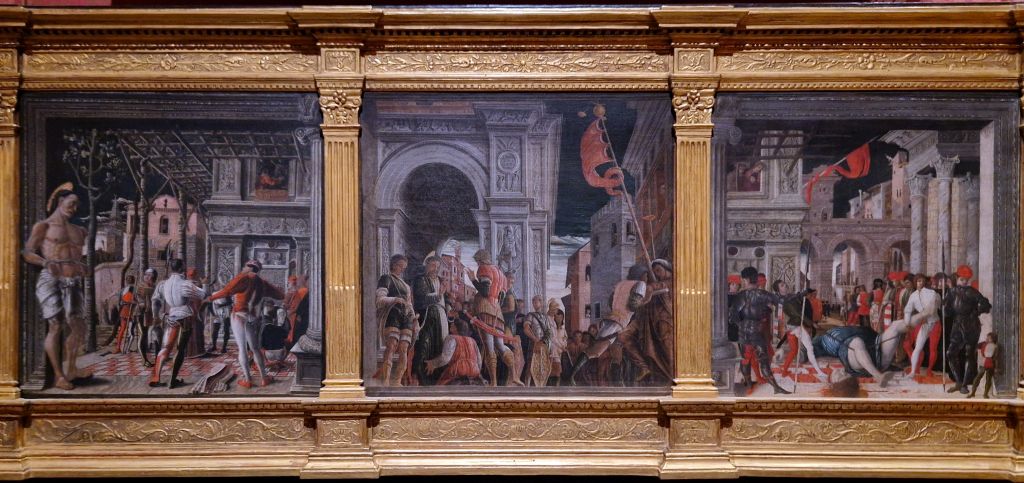
We refer here to a copy of the fresco now held at the Musée Jacquemart-André (the reasons for this are explained elsewhere). Mantegna certainly followed the account given in the Golden Legend.


A Perfect Perspective
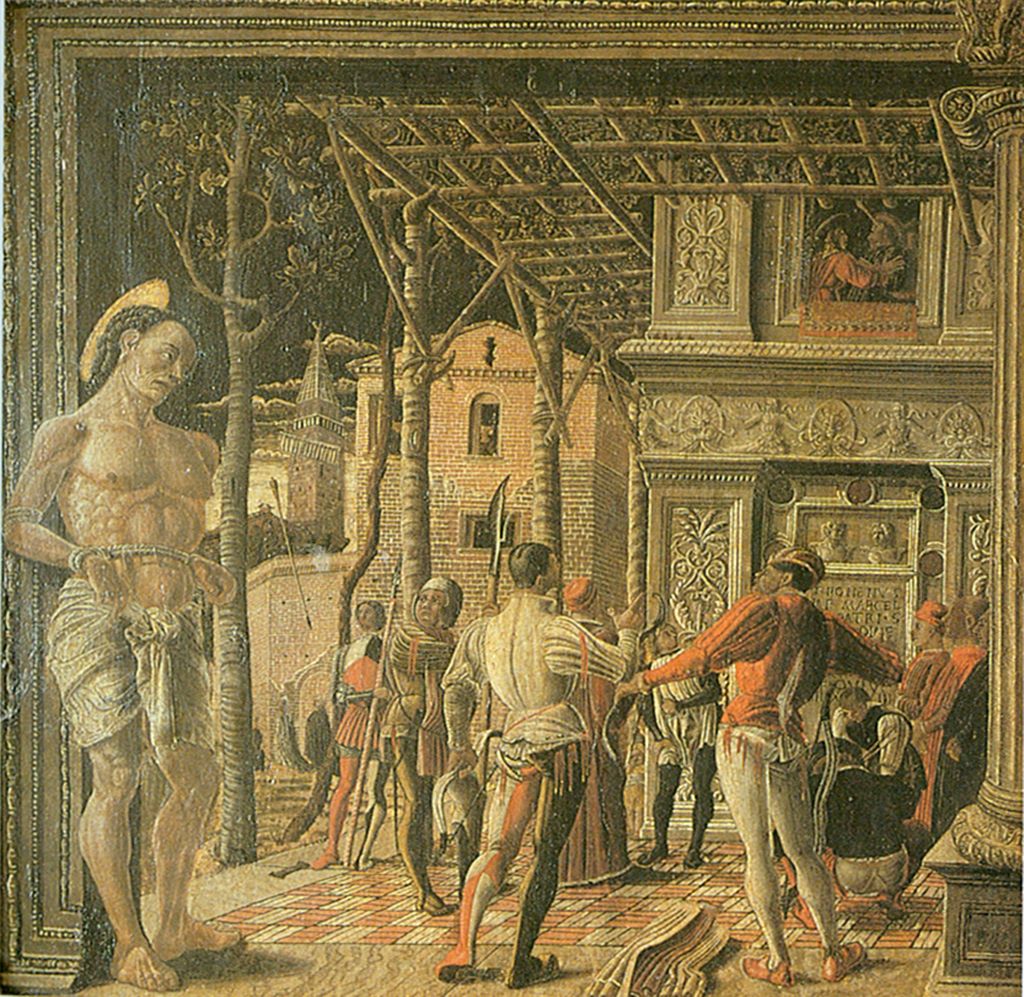
What strikes the eye first is the illusionistic perspectival framework of the fresco. Everything is rendered in perspective, masterfully controlled by the young painter, who places numerous buildings across different planes, drawing the eye toward depth — aided by a chequered floor and a pergola that mark the perspectival lines in an immediately visible way. And yet the scene unfolds close to us, so close that certain elements break through the frame (the colossal body of the bound saint in the first panel, his severed head in the second) and come toward us: the event draws us in as spectators, for the saint is ready to work miracles even for us. Let us not forget that the persecuting king himself was miraculously healed by the blood that flowed from the saint’s severed head.
A Column to Divide Before from After
Particularly interesting is the use of the central column, which divides the fresco in two — not so much spatially as temporally. Two successive scenes are depicted: the (attempted) martyrdom of the saint, and the transport of his decapitated body.
Archaeological Mysticism
The architecture represented belongs to both worlds of the artist: the contemporary (represented by the bell tower of St Mark’s and sections of the Walls of Padua in the background) and the classical (represented by the arcaded buildings, the small temple on the right, and the king’s palace, richly adorned with medallions and architraves). His operation seeks to connect past and present, classical antiquity and Christianity: Roberto Longhi called it archaeological mysticism.
The Characters, Each With Their Own Personality
The figures on the scene are arranged in groups, but they are not anonymous. Each character is defined by an emotion, expressed through posture and facial expression.
In the Martyrdom of Saint Christopher
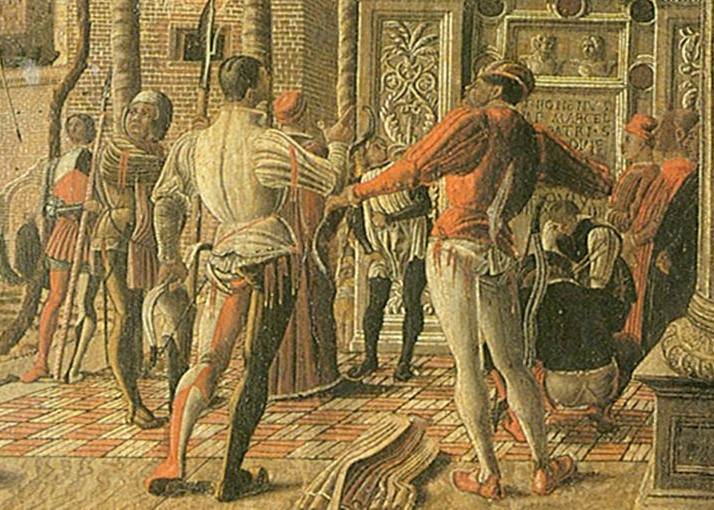
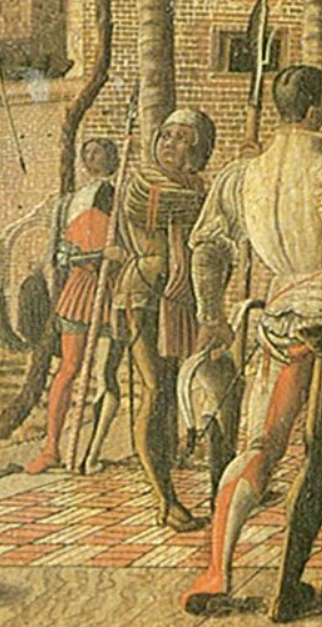
Among the archers who have tried to kill the saint, one turns to look at him in shock, because the arrow he fired has changed direction. Another looks toward the king who, while watching the martyrdom from the palace window, has been struck by an arrow in the eye. A third, in the foreground with his back to us, has just released his arrow and still holds his arms outstretched — but now those arms convey astonishment. His companion holds the bow in one hand and points toward the king with the other, making sure we don’t miss what has happened to him. Others are crouching on the ground, busy preparing to shoot — perhaps they haven’t yet, or perhaps they mean to try again. The only still figures in the scene are noblemen: they appear to have been frozen in place by the miracle.
In the Transport of the Body of Saint Christopher

Men and soldiers bustle about to move the saint’s colossal decapitated body. The rope placed under his legs emphasises the effort made by a young man and a soldier who leans back to call someone for help. Among the bystanders, many look on in amazement; two press close together, struck by what they see. Only the two soldiers in the foreground are distracted: one looks back toward the previous scene, while the other gazes at a child who is touching his leg. From the window, the healed king and two other figures watch the scene unfold.
The figures are well harmonised within the space, revealing Mantegna’s clear knowledge of Donatello’s bronze Miracle of Saint Anthony for the Altar of the Saint.
Saint Christopher’s monumentality and sacredness are unmistakable: a colossus, yet with an exceptionally defined torso, reflecting the characteristic anatomical precision that is so typical of Andrea Mantegna.
The Venetian Colours
Up to this point, the influences of the Renaissance artists who came north to spread the Tuscan revolution are clearly evident (Donatello, Piero della Francesca, and Leon Battista Alberti being the most important), as is the meditation on antiquity absorbed in Squarcione’s workshop. What is new for the young Mantegna is his use of colour: his closeness to the Bellini family and Venetian culture pushes the painter toward colours that are less enamel-like and more delicate than those he had learned from Squarcione (which would later be passed on to the Ferrarese tradition of Cosmè Tura, whose own Saint Christopher will be discussed elsewhere). The colours are now partly lost, but this can at least be observed in the background: white as the dominant colour that illuminates the entire scene, encompassing both buildings and figures; a dark, cloudy sky; green trees; and a beautiful red banner billowing in the wind.
From Tradition to Maturity: Mantegna 1449 – Mantegna 1457
Here, then, is Mantegna’s precocious yet already mature style — all the more visible when we compare the first Saint Christopher he painted for the chapel ceiling in 1449 with the masterpiece of 1457. Due to well-known events, the earlier fresco has come down to us only in a photograph taken before 1944.
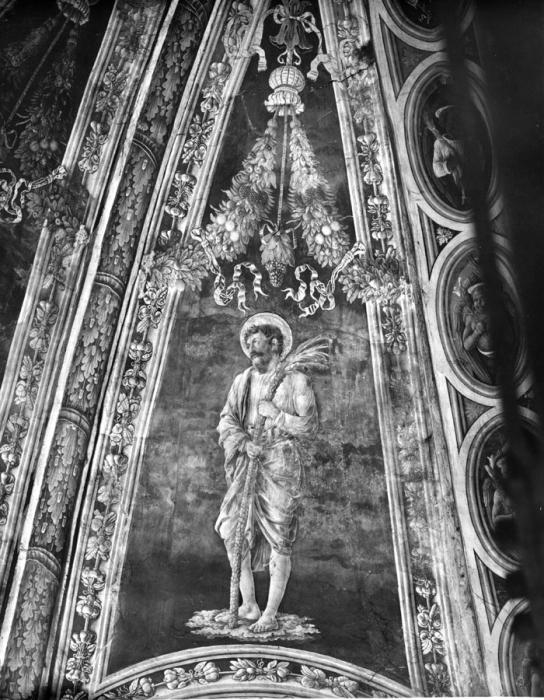
The depiction of the saint is fairly traditional and not at all dynamic. The Christ Child is absent, of course — but so too is the colossal scale of the saint, while heavy floral garlands almost brush against his head. Our Andrea Mantegna has come a long way in ten years!
N.B. The rather turbulent departure from Squarcione’s workshop left its mark on the fresco as well. It seems that Andrea gave the second archer on the left — the one staring in astonishment at Saint Christopher — the features, perhaps somewhat caricatured, of his former master. Not exactly a fond farewell!
On the Ovetari Chapel
Bibliography
- The story of the saints of the Ovetari Chapel, edited by PST Galileo, which oversaw the restoration
- @Claudio Pepi – Art History: From Squarcione to Mantegna
- Il nuovo Arte fra noi, edited by Cristina Fumarco, Pearson
- venetocultura.org