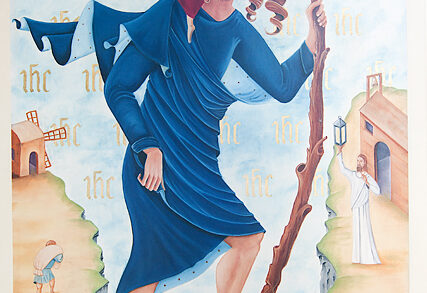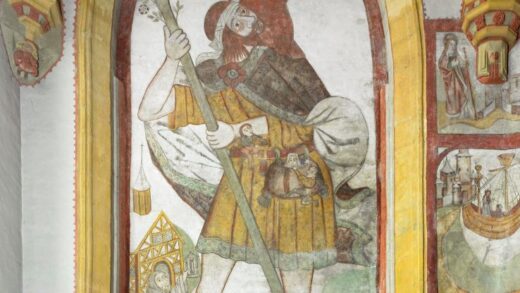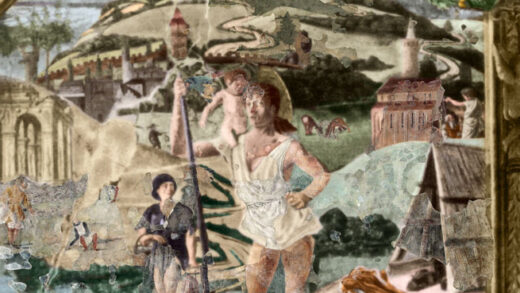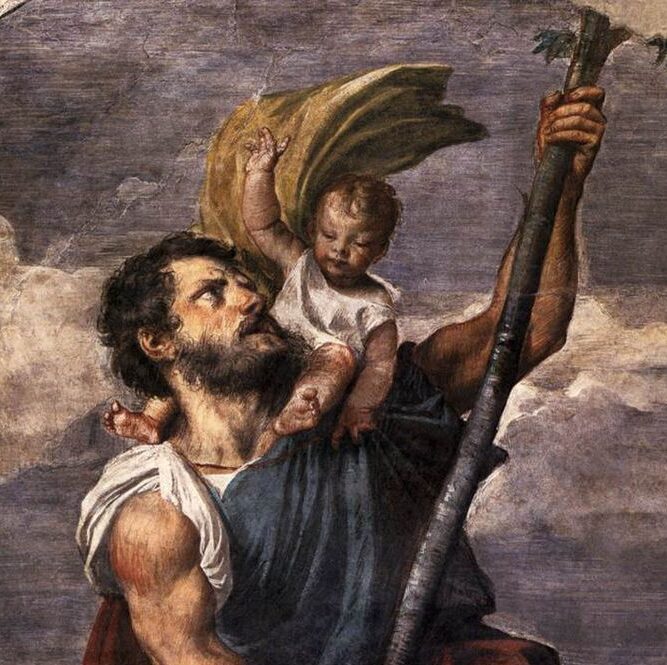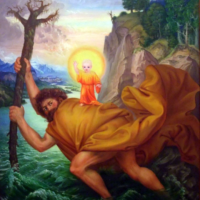
Otto Dix, the celebrated painter of the New Objectivity movement, was persecuted by the Nazi regime and included in the Degenerate Art exhibition. Forced into censorship, the artist retreated to Lake Constance, where he abandoned his more explicit social and war themes to devote himself to landscapes and religious subjects. Between 1937 and 1944, Dix produced several versions of Saint Christopher, using them as metaphors for the suffering and uncertainty during the dark years of Nazism and the Second World War.
Otto Dix and Nazism
Art as Resistance and the Stigma of “Degenerate Art”
After the Nazi rise to power in 1933, Otto Dix’s career suffered a dramatic interruption. The artist, a central figure of the New Objectivity (Neue Sachlichkeit), was targeted by Hitler’s regime for his raw aesthetic and corrosive vision of reality — utterly at odds with the triumphalist rhetoric of the Third Reich. The Nazi regime condemned Dix’s work, branding it “Degenerate Art” (Entartete Kunst). His paintings, particularly those depicting the horrors of the Great War without heroic filters, were stripped from museum walls and put on display as examples of the “moral corruption” of the German people.
The Exile at Constance
Persecuted and stripped of his professorship in Dresden, Dix chose “inner exile.” He withdrew with his family to the shores of Lake Constance, near the Swiss border. There, forced to soften his language in order to survive and retain patronage, he took refuge in landscape and religious iconography — domains in which he could conceal deeper, critical meanings.
Lake Constance and the Border
Lake Constance was not merely a physical refuge, but a liminal zone between Nazi Germany and the freedom of Switzerland. In this context, the figure of Saint Christopher — the giant who carries the Christ Child across treacherous waters — became the ideal metaphor for the condition of those trying to preserve innocence and truth in a time of darkness. Dix chose Saint Christopher to narrate, across six different canvases, the progressive slide of civilisation toward the abyss of the Second World War.
The Saint Christophers of Otto Dix (1937–1944)
(1937) Vatican Museums: Struggle and Hope
In the 1937 version, Dix presents an iconography that, while emphasising physical strain, still preserves a horizon of salvation. The saint is depicted as an old man bent under the weight of his burden, leaning on a branch as he crosses a broad stretch of water. The landscape, inspired by the mountains of the Bernina, appears still welcoming and luminous. The note of hope resides in the relationship between the bearer and the Child, whose divine presence is made explicit through a reference to the great tradition of German painting.
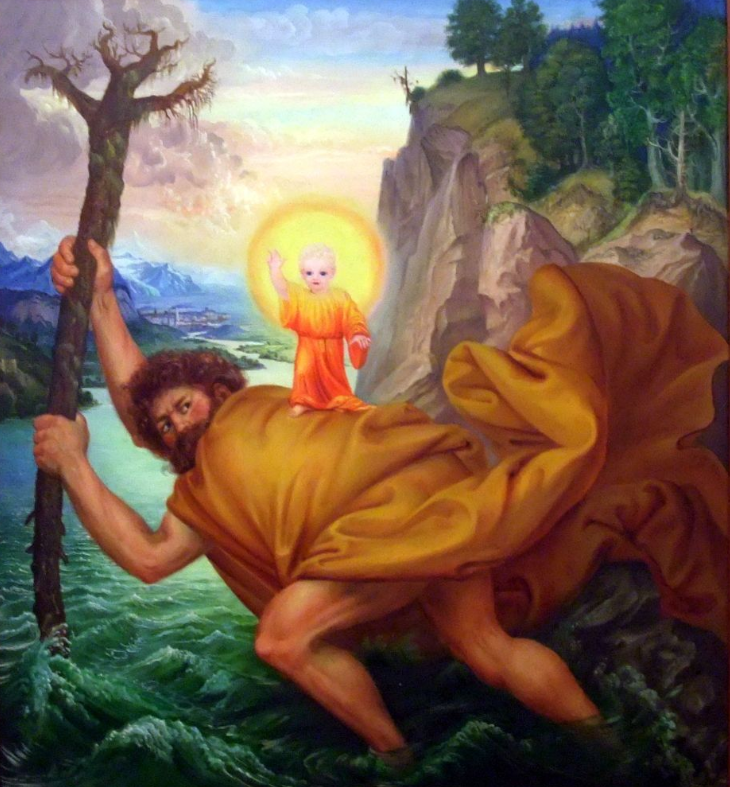
The Child, wrapped in robes that echo the tones of the saint’s own mantle, radiates a light that underscores his divinity and innocence. He is crowned by a luminous halo of remarkable modernity, inspired by that of the Risen Christ in Matthias Grünewald’s Isenheim Altarpiece. In these disastrous times, his gesture of blessing represents a promise of salvation, illuminating the path through the waters.

In Dix’s work, the hope of salvation is conveyed through the complicity between saint and Child — as though they must face a common struggle together — but also through the landscape itself: the waters are churning, yet the far shore still seems within reach.
And yet this balance between human fragility and divine protection begins to crack, dramatically, as the conflict draws nearer.
(1938) Gera: Judgement and Hostility (Saint Christopher IV)
Just one year later, the political climate is reflected in a disquieting iconographic transformation. In the version known as Saint Christopher IV, Dix abandons the serenity of the Vatican painting in favour of a more aggressive and symbolic aesthetic.

Here, the saint takes on a “wild,” almost feral appearance, drawn directly from a 1506 engraving by Lucas Cranach the Elder, which Dix had studied closely.

Comparing the source with Dix’s interpretation, several significant differences emerge. First, the Child is no longer a passenger to be protected, but a judge who surveys humanity from above. Furthermore, while Cranach’s Saint Christopher has one foot already on the bank — giving the impression that salvation is just one final effort away — Dix’s saint is still in the middle of the lake: the shore appears distant, and for the first time, reaching it becomes an uncertain prospect.
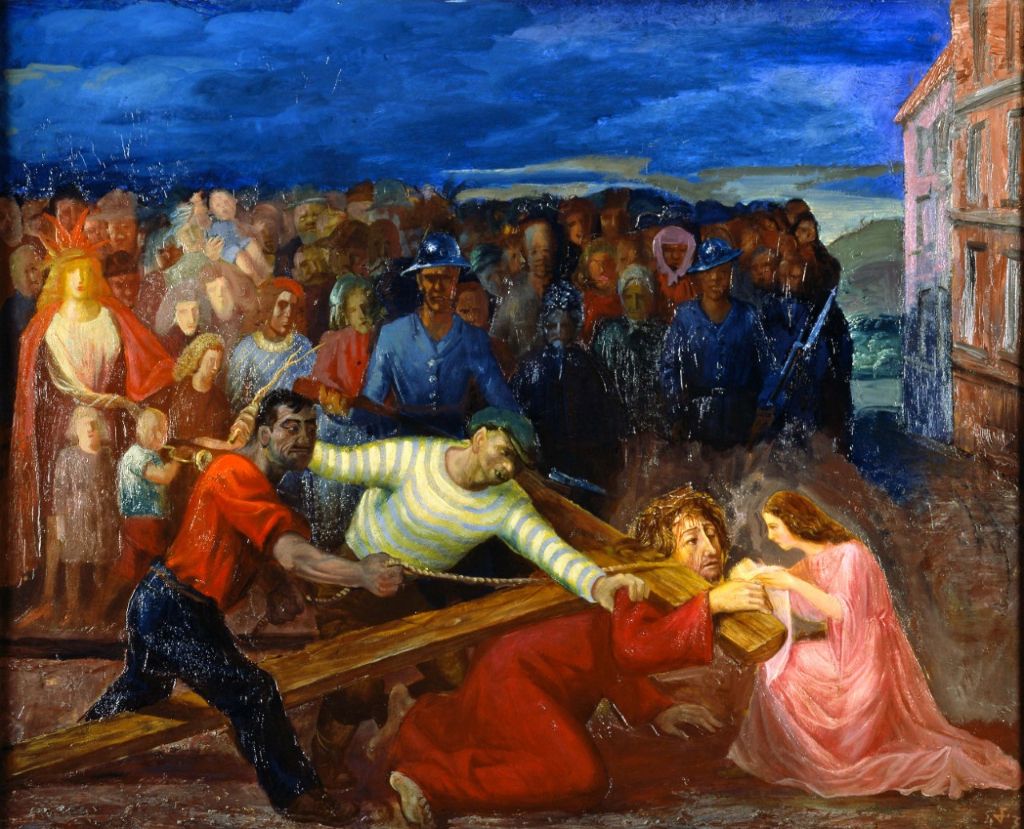
And yet a glimmer of hope remains: the pink of the saint’s robe. Dix associated these tones with gentleness and modesty, as can be seen in the figure of Veronica in his 1943 Crucifixion.
(1944) Chemnitz: The Monster and the Storm (Saint Christopher VI)
The 1944 work marks the culmination of the transformation: we are no longer before a devotional image, but before an apocalyptic vision of the collapse of Germany and of humanity itself. The painting shows Saint Christopher viewed from behind — an iconographic choice that erases his human identity and turns him into an element of the landscape itself. The saint has become a “monster,” part of the chaos, indistinguishable from the natural forces around him. There is no longer any boundary between the giant’s body and the raging sea.
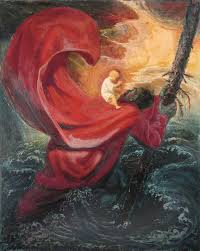
The fabric of his robe dissolves into a cloud-like mass with reddish glows — the colours of wartime fires and storm-swept skies — erasing every line between man and catastrophe. The Child has been reduced to a fragile flicker of light. Balanced precariously on the shoulders of this beast rising from the waters, he no longer seems capable of mastering the storm. The question the painting poses is whether that small flame of innocence can survive the monster carrying it through the blood-soaked darkness of 1944.
From Saint to Monster
These works reveal a profound stylistic evolution, transforming the saint from a protective figure into an almost monstrous being submerged in apocalyptic scenes. Across these canvases, the Christ Child represents a fragile light of hope — or of judgement — struggling to survive in a world consumed by destruction and death. Dix thus reinterpreted traditional iconography to reflect the tragic human condition under dictatorship and war.
On the YouTube channel @sullespalledisancristoforo
Bibliography and Sitography
- Bibliografia Otto Dix, edizione Mazzotta, 1997
- Finestre sull’arte: Otto Dix. La vita e le opere del maestro della Neue Sachlichkeit
- Maria Mezzatesta, Otto Dix, la Guerra in ogni aspetto squarcia disegno e tela
- Johannes Eichenthal, DIX UND HINDEMITH
- Der heilige Christophorus IV