Who Is Saint Christopher? Here’s everything you need to know about the saint! This page is also an index of sullespalledisanCristoforo italian website.
Christopher of Lycia
Saint Christopher is venerated in both the Catholic and Orthodox churches.
According to tradition — recorded in Jacopo da Varazze’s Legenda Aurea — he lived in the third century and died a martyr in Samos, in Lycia, in 250 AD, during the Decian persecution. His burial place is unknown.
His feast day falls on July 25 in the West, and May 9 in the East.
The Patronages of Saint Christopher
Saint Christopher is honored as the patron of all who carry people and goods from one place to another: pilgrims, travelers, ferrymen, boatmen, pilots, truck drivers, railway workers, drivers, motorcyclists, porters, stevedores, and cobblers. He is also the patron of those who perform physical labor — mountaineers, athletes, surfers, and sailors — as well as gardeners and fruit vendors. He is additionally the protector of unmarried men. He is invoked against various ailments, particularly sudden death and the plague, but also against eye diseases, hand infections, epileptic seizures, and toothache. He offers protection from lightning, storms, and floods.
The Geography of Saint Christopher
Devotion to Saint Christopher is widespread throughout the world, but especially in Italy, Austria, Croatia, Slovenia, Germany, Belgium, Switzerland, France, and Spain. The saint has also crossed the Atlantic and reached as far as the Indian Ocean.
Where is Saint Christopher depicted? At mountain passes, along valleys, along ancient roads and trade routes, beside great (and small) rivers, in the mountains, and on the plains.
Sources on the Life of Saint Christopher
Sources Before the Golden Legend
Extensive written accounts of Saint Christopher’s life are attested from the ninth century onward, though they were likely in circulation earlier. They exist in Greek, Latin, Old English, and Old High German.
The Primary Source: Jacopo da Varagine’s Legenda Aurea
The Legenda Aurea, written by Jacopo da Varagine in the thirteenth century, is not the only source — but it is certainly the most important account of Christopher’s life, death, and miracles. Here is a summary of the chapter dedicated to the saint (the full text in the original Latin is also available on the site).
Christopher was a Canaanite of enormous stature and fearsome appearance. Having resolved to serve the most powerful man in the world, he presented himself to his country’s king.
Before long, however, he noticed that the king lived in fear of the devil. So Christopher went in search of the devil, found him, and entered his service. But even the devil feared someone more powerful than himself: the Crucified Christ. And so Christopher — who at that time still bore the name Reprobus — set out in search of Christ. He found a hermit who gave him a task: to carry people across a river. In this way, the hermit told him, he would eventually encounter Christ.
One day, a child asked Christopher to carry him to the other bank. As they crossed, the child grew heavier and heavier. Christopher asked why, and discovered that the child was the Creator of the world — the greatest Lord of all. To give Christopher definitive proof, the child instructed him to plant his staff in the ground: by morning, it would have blossomed. And indeed, the next day Christopher found the staff in bloom and laden with dates.
Christopher then began preaching the Gospel in Samos, where he converted many soldiers and earned the hostility of King Dagno, who had him arrested.
Christopher managed to convert many of his fellow prisoners, and even two prostitutes — Niceta and Aquilina — whom Dagno had sent to his cell in an attempt to corrupt him.
In the end, Dagno resolved to have the saint killed. After subjecting him to various tortures, he ordered that Christopher be shot with arrows. During the execution, however, one arrow suddenly changed course and struck the king in the eye. The saint prophesied that he would be healed.
Having survived the arrows, Christopher met his martyrdom through beheading.
His blood, mixed with earth and placed on Dagno’s eye, cured the king. Dagno realized he had put an innocent man to death, proclaimed Christopher a saint, and ordered that everyone honor him.
Did Saint Christopher Really Exist?
The story of Saint Christopher has been examined across multiple historical sources, but scholars have yet to reach a consensus. His historical existence remains in doubt — though it cannot be ruled out. The reconstruction proposed by historian Stefano Borsi, in particular, strikes me as very compelling.
Saint Christopher: Between Christianity and Paganism
Saint Christopher’s enduring popularity owes much to the way he absorbed the characteristics of pagan gods and heroes that Christianity encountered throughout its history.
In the transition from paganism to Christianity, Christopher came to replace Hercules (powerful, leaning on his club), Anubis (the Egyptian jackal-headed god of the dead, popular in Rome), Hermanubi (a Greco-Egyptian syncretic deity, psychopomp and protector of travelers), and Atlas (condemned to bear the world on his shoulders).
As Christianity spread among pagan peoples, Christopher also took on traits from Etruscan, Celtic (such as Bergimus or Lugh), Venetic (such as Aponus), Lombard, and Finnish deities.
There is also a striking connection between Christopher and the star Sirius: the saint’s feast day falls in the height of summer, when Sirius rises and sets with the sun.
Depictions of Saint Christopher Through the Centuries
The most common Iconography
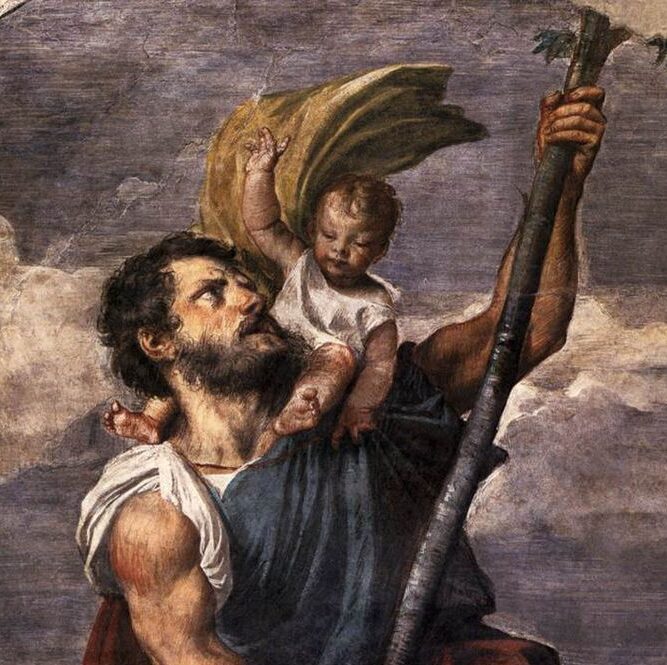
Saint Christopher is generally depicted as a giant of a man carrying a Child on his shoulders as he wades across a river. Sometimes additional details are included, such as a hermit waiting on the far bank holding a lantern, or aquatic creatures in the river below.
From the Eighth to the Thirteenth Century
In the earliest images, the saint is portrayed as a soldier — or even a king — holding a staff. The classic ferryman image may itself be a visual attempt to represent the saint’s role as the one who carries Christ, as his very name suggests (from the Greek Christophoros, “Christ-bearer”).
The Cynocephalic Saint Christopher
In the Orthodox tradition, Saint Christopher is depicted with the head of a dog — a cynocephalus. This iconography, which persisted for several centuries, has since been superseded by the ferryman image.
The Golden Age of Saint Christopher
From the thirteenth century onward, the saint was depicted on the façades of nearly every church, especially near streams, rivers, fords, bridges, and the old roads traveled by merchants and pilgrims. The fourteenth and fifteenth centuries were his golden age.
Saint Christopher under the scrutiny of the Reformation
From the sixteenth century, the saint began to fall under suspicion. Devotion to his image was seen as superstitious — a quality that displeased humanists, reformers, and Tridentine bishops alike. Critical scholarship on the sources of his life led many to conclude that the figure was legendary rather than historical. The question is still debated today.
Even so, Christopher continued to be represented, though with different roles: sometimes tucked into the background of paintings, sometimes chosen to embody the struggle of the Christian against temptation and life’s hardships, shown kneeling before the enthroned Madonna and Child.
A New Opportunity in the Twentieth Century
The saint came back into fashion in the early twentieth century, when he was proclaimed patron first of telegraph operators and railway workers, then of motorists. After the Second World War — with particular popularity in the 1970s and ’80s — he became a saint widely invoked before any car journey.
This era also saw the long story of the Saint Christopher medal, believed to protect against all manner of harm, including the dangers of war.
And in the Twenty-First Century?
Saint Christopher remains a powerful symbol, one that contemporary artists continue to interpret and reimagine.
A Brief Bibliography
- Stefano Borsi, Storia di san Cristoforo. Origini e diffusione di un culto tra mito e realtà, Libria, 2017
- Marta Paraventi, In viaggio con san Cristoforo. Pellegrinaggi e devozione tra Medioevo e età moderna, Giunti, 2000
- Eleonor Elisabeth Pridgeon, Saint Christopher Wall Paintings in English and Welsh Churches c. 1250–c.1500, University of Leicester, Thesis, 2008
- Pierre Saintyves, Dal santo agli dei. San Cristoforo successore d’Anubi, di Ermes e di Ercole, Eleusi, 2012
- Wikipedia entries: San Cristoforo, Christophorus, Saint Christopher, Christophe de Lycie, Saint Christophe portant l’Enfant Jésus