Saint Christopher in Zepperen, Sint-Truiden
The Saint Christopher among the late Gothic frescoes (1509) of the Church of Saint Genevieve in Zepperen has truly extraordinary characteristics. Zepperen is a hamlet in the municipality of Sint-Truiden, located in Flanders, a region that experienced various dominations and influences throughout its history — and all of them can be seen in our Saint Christopher. Three broad cultural matrices (the Germanic, the Anglo-French, and the Spanish) contributed to the creation of an image that straddles many cultures.
But let us begin with a description of the image.
Saint Christopher in Zepperen, Sint-Truiden: Description
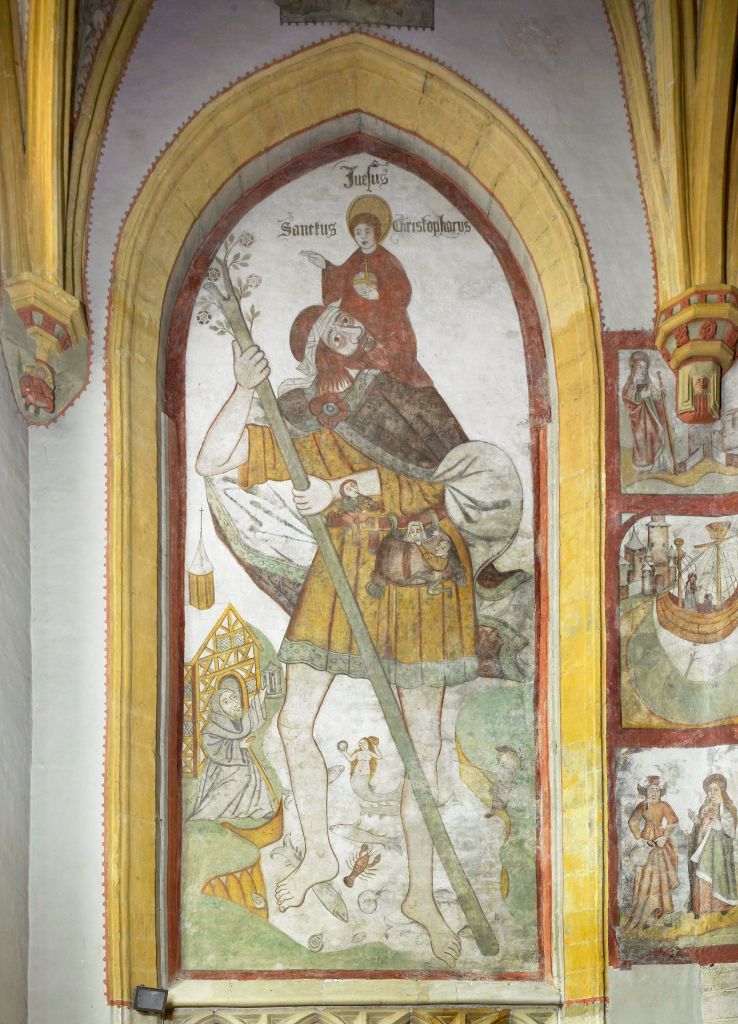
The image presents a fresco of Saint Christopher set within a painted ogival niche, which frames the scene in warm ochre and red tones and helps emphasise the verticality of the composition. The work displays characteristics of late medieval painting, with a linear draughtsmanship, colours now softened by time, and a still relatively simple spatial construction.
Saint Christopher, the Giant with His Feet in the Water
The figure of the saint completely dominates the space, following a dimensional hierarchy typical of his iconography: he is depicted as a giant, with a powerful body and his feet immersed in water, in the act of crossing a river. His face is characterised by long hair, held in place by a twisted and rolled headband, a thick reddish beard, strongly marked features, and a gaze directed upward, towards the Child he carries on his shoulders. The expression conveys intense effort, consistent with the narrative moment of the crossing. He wears a short yellow-ochre decorated tunic and a green cloak draped over his shoulders; at his waist he carries a satchel, an element that evokes his identity as a wayfarer. He is barefoot, and the water through which he walks is rendered in a stylised manner, with small fish and details that animate the riverbed.
Christopher leans on a long green staff, inclined diagonally, which crosses the composition and serves as a visual axis. The staff is not a mere functional element — it appears alive, with shoots and leaves, alluding to the miracle of the flowering and to the theme of life springing from faith.
The Child ‘Jesus’
On his shoulders sits the Christ Child, depicted frontally and in a stable position, dressed in red. With one hand he blesses, while with the other he holds the globus cruciger, a symbol of Christ’s universal dominion. Above his head the name “Jesus” can be clearly read, while next to the figure of the saint the inscription “Sanctus Cristophorus” appears, identifying the subject without ambiguity.
A Composite Landscape
In the lower left a small building appears, probably a chapel, beside which the figure of a hermit with a lantern can be distinguished: this is a recurring element in the legend, as the hermit helped wayfarers find the ford by lighting their path.
Meeting in Flanders: A Truly European Saint Christopher
The Headband of the Germanic Saint Christopher
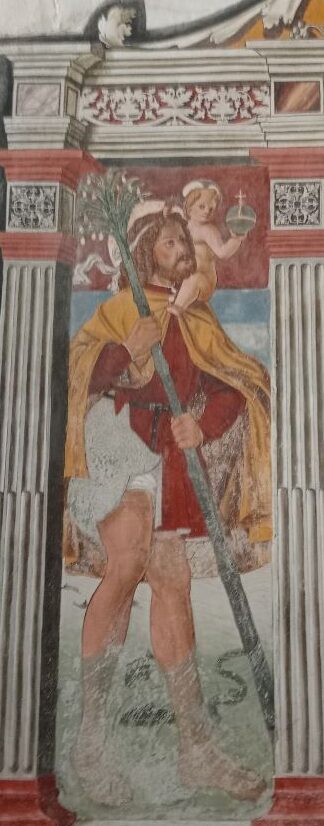
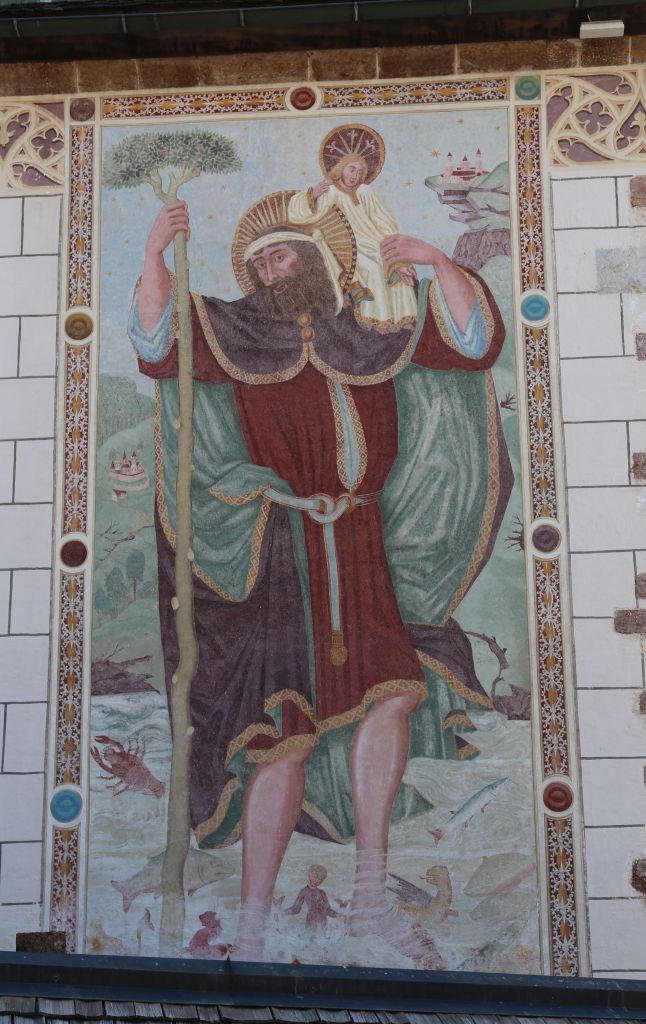
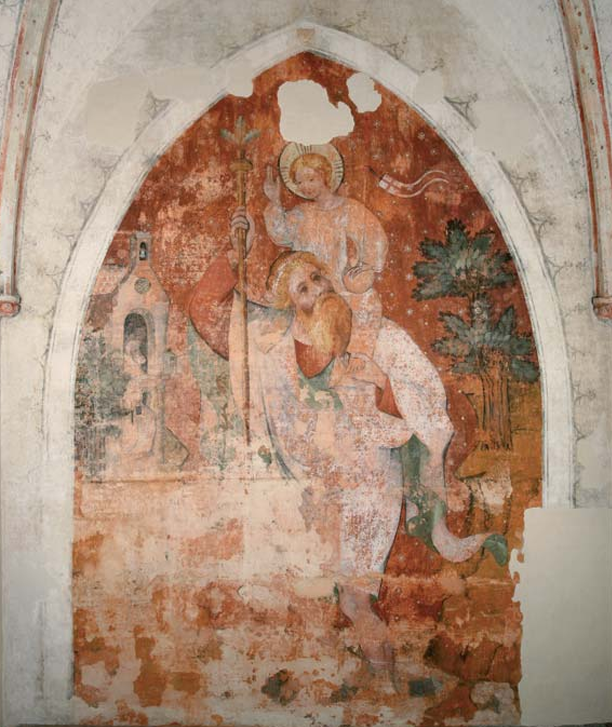
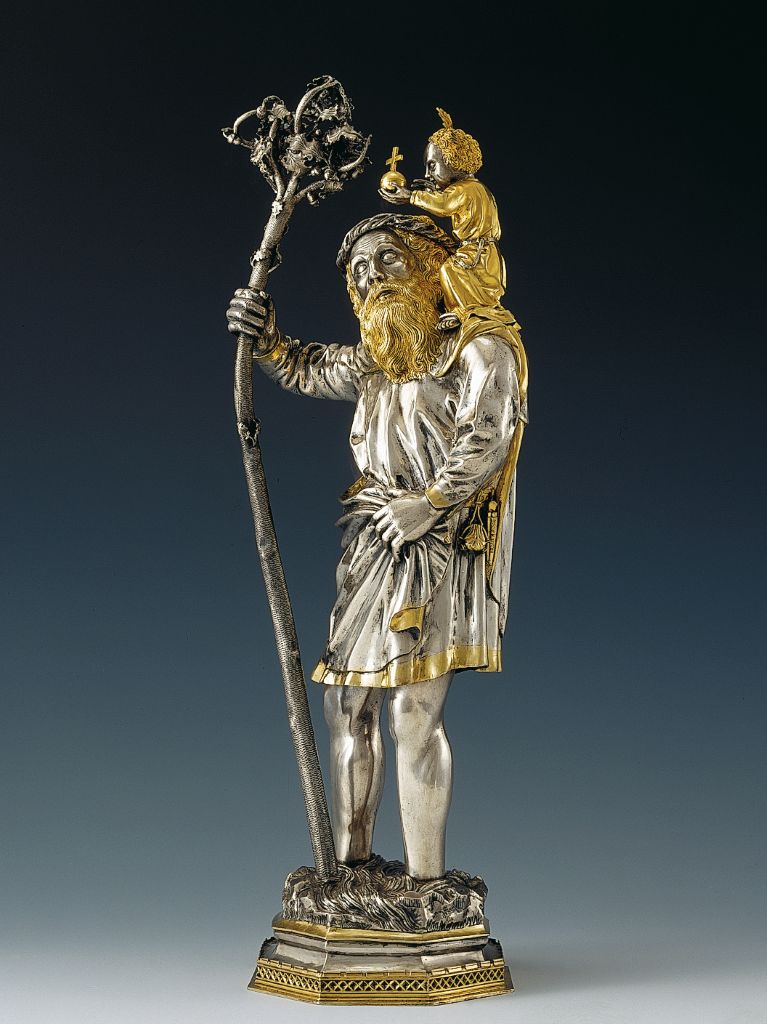
On his temples, Christopher wears a white twisted and rolled headband: this is a well-established feature in Germanic depictions of the saint and was readily adopted in Flemish painting of the period. It represents the penitential aspect of Christopher’s task, as well as a reference to the anointing of baptism and confirmation. The dishevelled and tousled hair is thus contained by the sacredness of the act the saint is performing. We can admire several examples.

A Flowering Palm — or Rather, a Germanic Oak
Another element typical of the Germanic tradition is the blossoming of the staff not with palm leaves and dates, but with various flowers and fruits, and in particular with oak leaves. And we have already seen how the oak is a tree of powerful symbolic value among Germanic peoples.

An Exceptionally Rich Aquatic Fauna
The aquatic fauna at the saint’s feet is also characteristic of the Germanic world. At the feet of the Saint Christopher of Zepperen there are at least eight fish of various sizes and species, some small snails, and a crayfish/lobster. And a beautiful mermaid.
The Difficulty of Conversion
Among the saint’s feet this marine fauna is often depicted to symbolise the difficulties of the crossing, the monstrous obstacles that seek to prevent the saint from carrying the Child to the other side. And if the crossing for Reprobus-Christopher also represents a change of life, a conversion, then these creatures are a spiritual obstacle as well.
The Vain Mermaid
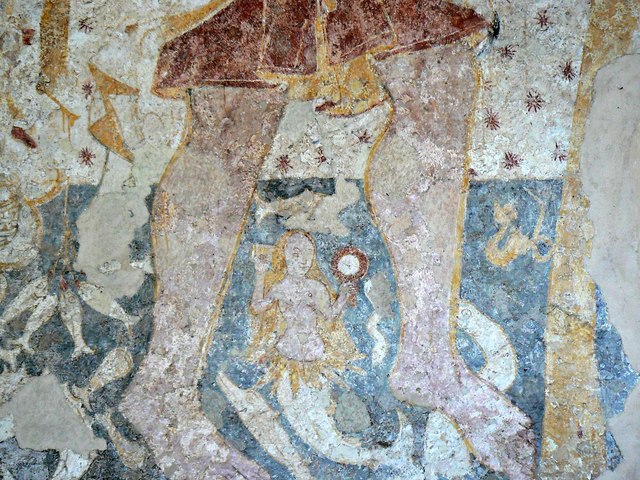
This is made explicit through the beautiful mermaid, who here carries an overtly symbolic meaning. The mermaid is gazing at herself in a mirror and combing her hair: she is evidently a symbol of vanity and seduction, with her hair flowing loose along her flanks, her long tail, and her position — particularly troublesome for the saint’s continued crossing.
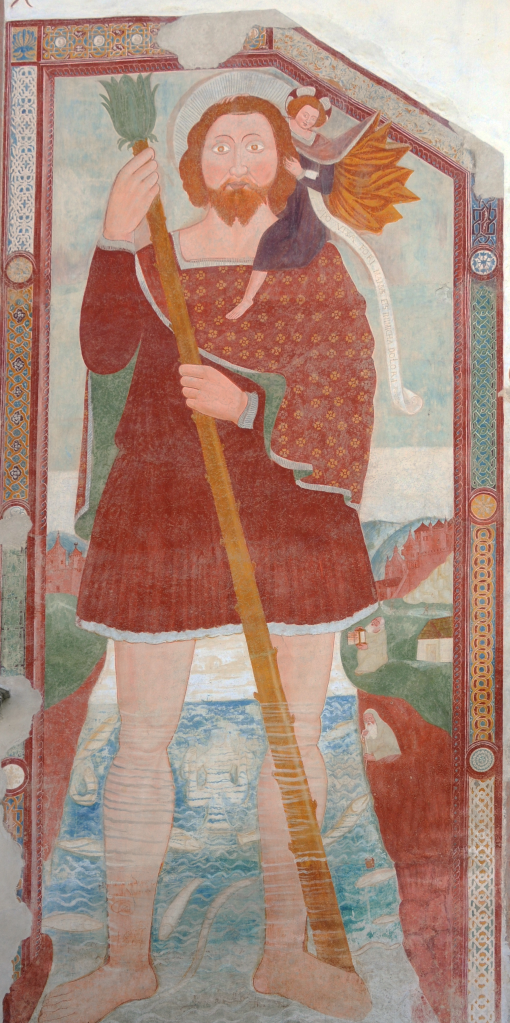
The mermaid is often depicted at the saint’s feet, but more commonly in her monstrous, bicaudate form, with a more ambiguous and less explicit meaning, as we have already explored — as at Spilimbergo, in Friuli.
In England and Wales, however, depictions of mermaids gazing into mirrors are very common. The best-preserved example is found in the Church of All Saints at Oaksey, Wiltshire, England. In that fresco, dating to the 15th century, many specimens of aquatic fauna are also present, including monstrous ones.
An Astronomical Crayfish/Lobster?
At Zepperen, a crayfish also appears among the saint’s feet. Interesting to note that the crustacean appears in depictions of the saint far older than this one (such as at Gemona), with a clear reference to the solstice and the dog days of summer. But the crayfish also appears in 15th- and 16th-century representations, perhaps retaining the same symbolic value as the fish and molluscs.

The Hermit and the Fisherman
The Hermit Who Lights the Way
Also of great interest are the two figures present in the landscape. More traditional is the presence of the hermit, who plays an important role in the Golden Legend and is found in almost every depiction, especially in transalpine representations from the 15th and 16th centuries.
The hermit, leaning on a staff, illuminates the saint’s path with a lantern, standing before a church with a timber-framed façade and a fine bell tower.
A Fisherman … or the Devil?
Far more unusual is the fisherman casting his line into the water. This image is found in England, in frescoes of the period depicting the saint. Who is this fisherman? A simple figure chosen for realistic effect? A greedy monk who is fishing? perhaps even the Devil fishing for souls?
The Pilgrims Hanging from His Belt
But the most intriguing detail of the depiction is found in the central section, around the saint’s belt. Hanging from the leather girdle is a small bag, an essential accessory for travellers and a frequent feature in depictions of the saint who is the patron of pilgrims and wayfarers. But here, between the figurines of pilgrims, some are cheerfully hitching a ride on the saint! One is astride the belt and playing a flute; another is hanging from the satchel, awkwardly trying to climb inside the purse — from which a woman dressed in white gazes out at us. The three young figures represent merry pilgrims, comfortably carried along by their protector.
This iconography is characteristic of Spanish depictions of the saint: pilgrims hanging from the belt, alongside a millstone on the arm, serve as a symbol not only of the saint’s patronage but also of his colossal stature and superhuman strength. This type of representation is in fact very widespread.
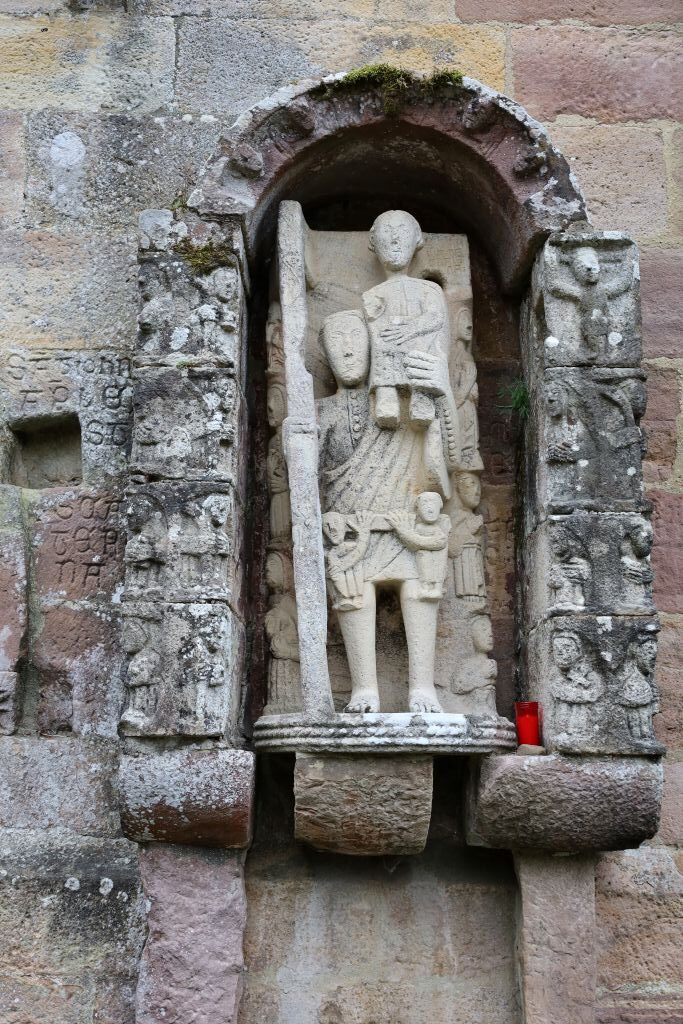
In the Belgian fresco the millstone is absent — perhaps felt to be too much — but the delightful pilgrims hanging from his belt and having ended up, snug and comfortable, inside the satchel are all there!
The Belgian Saint Christopher, Patron of All European Pilgrims
The Saint Christopher of Zepperen is, then, an example of a cosmopolitan saint in an interconnected world: after all, the saint of pilgrims could not but gather elements from here and there, carrying them upon himself and weaving together the story of the roads of Europe. And so we find the Germanic headband, oak, hermit and cloak; the Iberian pilgrims hanging from the belt; and the mirror-gazing mermaid and the fisherman from the Anglo-French tradition — all united in a Belgian Saint Christopher, patron of all European pilgrims.
The Last Judgement of Zepperen
And if the magnificent cosmopolitan Saint Christopher is not enough for you, the Church of Saint Genevieve also contains an extraordinary Last Judgement, painted by the same hand as the Saint Christopher.
Bibliography
- Bergmans, A., & Buyle, M. (2013). “Internationale stijl” in Mechelen: ontdekking, conservatie en onderzoek van de muurschilderingen van rond 1400 in de toren van de Sint-Janskerk. RELICTA (BRUSSEL), 10, 129–207.
- Wikipedia page: Church of Saint Genevieve